
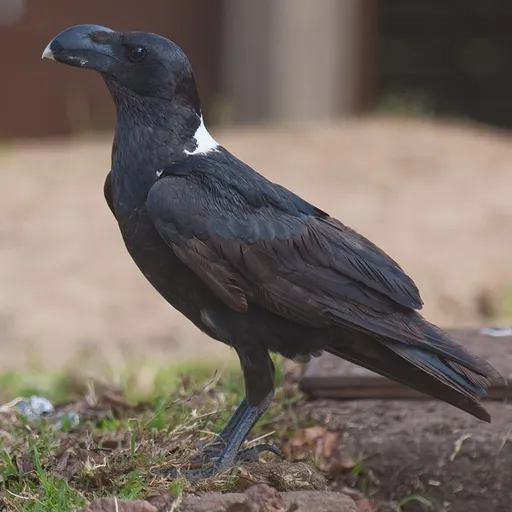
White-necked Raven
Corvus albicollis
Least Concern
Overview
The white-necked raven, also known as the collared raven, is a species of raven native to eastern and southern Africa. It is somewhat smaller than the common raven or its nearest relative, the thick-billed raven, measuring 50–54 cm in length.
Identification
- Length: 50–54 cm; wingspan: 752–860 mm; weight: 762–865 g.
- Predominantly black plumage with a faint purple gloss on the throat, breast, and neck, and a large patch of white feathers on the nape of the neck.
- Features a deep bill with a white tip that is almost as strongly arched as that of the thick-billed raven, and a much shorter tail than the common raven.
- Vocalisations are described as having a husky, whispering note, often likened to a raven with a sore throat.
Habitat
The species occurs in eastern and southern Africa in open, mountainous country and is associated with mountains where it nests on cliff ledges. It is commonly found in montane grasslands and is quite commonly found in small towns and villages provided there are mountains or hills nearby for roosting and nesting.
Diet
The white-necked raven is omnivorous, feeding on both vegetable and animal matter such as fruit, grain, insects, small reptiles, peanuts, and human food. Most food is obtained from the ground, but it also takes food from trees and readily consumes carrion from road kills. It has been observed to drop tortoises from a height onto hard ground or rocks to break them before eating.
Did you know?
Although capable of vocal mimicry like all corvids, this behaviour in the white-necked raven has only ever been recorded in captivity.
Sources
- Wikipedia · CC BY-SA 4.0
- Wikidata · CC0 1.0