
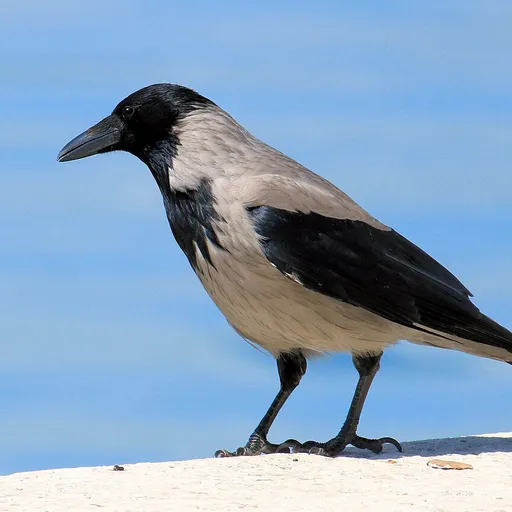
Hooded Crow
Corvus cornix
Listen
XC901768 · Jochem verweij · Mörbylånga Municipality, Kalmar County, Sweden · CC BY-SA 4.0
Overview
The hooded crow (Corvus cornix) is a Eurasian bird that was previously classified as a subspecies of the carrion crow (Corvus corone) before being recognised as a distinct species in 2002, though recent global classifications have reverted it to a subspecies status. It is widely distributed across Northern, Eastern, and Southeastern Europe, as well as parts of the Middle East.
Identification
- Ash-grey body plumage with a distinctive black head, throat, wings, tail, and thigh feathers.
- Black bill and legs, with dark brown irises.
- Length varies from 48 to 52 cm, with a wingspan of approximately 105 cm.
- Flight is slow, heavy, and usually straight.
- Call notes are almost indistinguishable from those of the carrion crow.
Habitat
The species breeds in northern and eastern Europe, with closely allied forms inhabiting southern Europe and western Asia. In the British Isles, it breeds regularly in northern and western Scotland, the Isle of Man, the Scottish Islands, and throughout Ireland. Fertile hybrids are produced where its range meets that of the carrion crow in regions such as northern Britain, Germany, and Denmark.
Diet
As an omnivorous and opportunistic forager, the hooded crow is a constant scavenger that feeds on small mammals, scraps, smaller birds, and carrion. It drops molluscs and crabs to break them open and steals eggs from the nests of gulls, cormorants, and puffins. The bird often hides food, such as meat and nuts, in locations like rain gutters, flower pots, or under bushes to feed on later.
Did you know?
An old Scottish name for empty sea urchin shells was "crow's cups" due to the habit of hooded crows dropping them to break them open. In Faroese folklore, a maiden would throw a stone, a bone, and turf at a hooded crow on Candlemas morn; if the bird flew over the sea, her husband would be a foreigner, while staying put signified she would remain unmarried.