
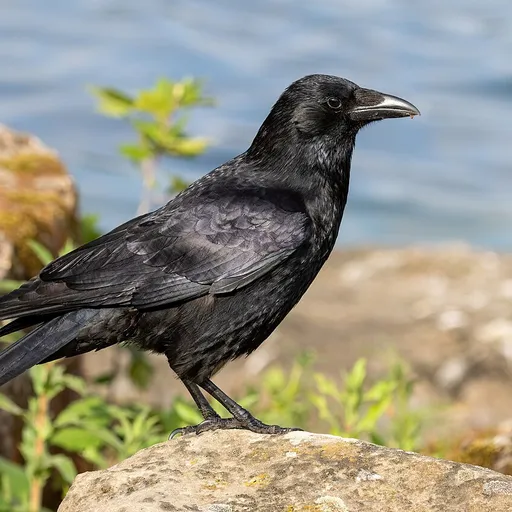
Carrion Crow
Corvus corone
Least Concern
Listen
XC707409 · Sonothèque ADVL · Carolles, Manche, Normandie, France · CC0 1.0
Overview
The carrion crow (Corvus corone) is a passerine bird native to western Europe and the eastern Palearctic. It is listed on the IUCN Red List as a species of Least Concern.
Identification
- All-black plumage with a strong green or purple sheen, distinguishing it from the greener gloss of the rook.
- Size ranges from 48–52 cm in length with a wingspan of 84–100 cm, making it stockier and larger than the American crow but smaller than the common raven.
- Bill, legs, and feet are entirely black.
- A deep, guttural, and slightly vibrant croaked kraa that is distinct from the high-pitched call of the rook.
Habitat
The carrion crow occupies a wide range of environments, including mountains, forests, cities, moors, woodland, sea cliffs, and farmland. It is frequently found near areas of human activity where it competes with gulls, other corvids, and ducks for food.
Diet
A versatile scavenger, the carrion crow feeds on insects, earthworms, grain, fruits, seeds, nuts, small mammals, amphibians, fish, and human food scraps. It actively hunts and harasses other birds or foxes to steal kills and occasionally cooperates with other crows to catch prey such as ducklings.
Did you know?
Carrion crows demonstrate remarkable intelligence, capable of discriminating between numbers up to 30, flexibly switching between rules, and recognising individual human and crow faces.
Sources
- Wikipedia · CC BY-SA 4.0
- Wikidata · CC0 1.0