
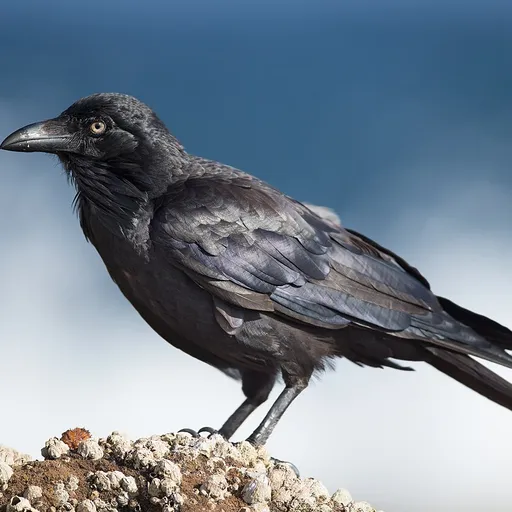
Australian Raven
Corvus coronoides
Least Concern
Overview
The Australian raven (Corvus coronoides) is a passerine corvid and Australia's largest species of raven, distinguished from crows by its grey feather bases and prominent throat hackles. It is classified as Least Concern by the IUCN and is common throughout eastern and southern Western Australia, where it has successfully adapted to urban environments.
Identification
- All-black plumage with a glossy blue-purple or greenish sheen on the upperparts; feathers have grey bases (visible when ruffled), which distinguishes it from crows that have white bases.
- Long, lanceolate throat feathers, or hackles, which give the bird a bearded appearance when raised, unlike the shorter, bifurcate tips of other Australian corvids.
- Large, heavy-set bill that is longer than the head, tipped with a slight hook, and features a bare patch of skin under and beside the bill.
- Territorial call is a slow, high ah-ah-aaaah with the final note drawn out; delivered in a horizontal posture with the head held forward, contrasting with the upright posture of other ravens.
Habitat
The species inhabits open woodlands, transitional zones, eucalypt-dominated sclerophyll forest, and heath, as well as urban areas such as Sydney, Canberra, and Perth. It requires access to water and trees or buildings for roosting and is often found near farmland, particularly sheep stations, where it scavenges on carrion. It is rare in the Australian Alps, where it is replaced by the little raven.
Diet
An omnivorous and opportunistic feeder, it consumes fruits, seeds, lizards, small mammals, and the chicks of other bird species. It frequently scours waste bins for human food waste and acts as a scavenger on carrion, including the afterbirth of sheep. It is rarely, if ever, responsible for killing lambs, as it is likely attracted to the birth process to consume the placenta.
Did you know?
The species is locally known as wugan, a name derived from the Eora and Darug Aboriginal languages of the Sydney Basin. Additionally, it has historically been called 'Kelly', a name that emerged in the 1920s possibly alluding to the notorious Kelly Gang.
Sources
- Wikipedia · CC BY-SA 4.0
- Wikidata · CC0 1.0