
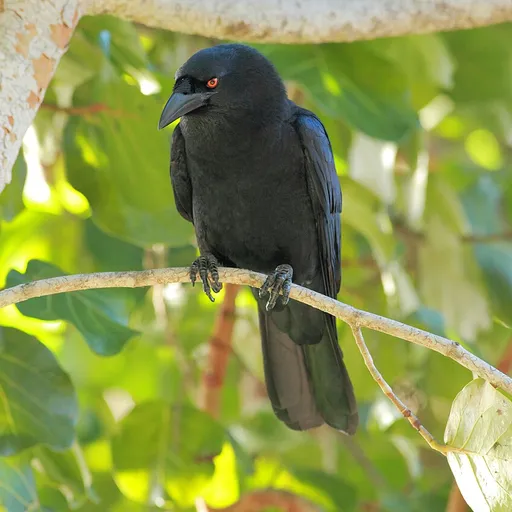
White-necked Crow
Corvus leucognaphalus
Vulnerable
Overview
The white-necked crow (Corvus leucognaphalus) is the largest of the four Caribbean corvids and is endemic to the island of Hispaniola. It is currently listed as Vulnerable by the IUCN due to habitat destruction, hunting, and a severely fragmented population that is mostly decreasing.
Identification
- A stocky bird measuring 42–46 centimetres in length, with an overall black appearance that exhibits a bluish-purple gloss in good light.
- Despite its name, the neck typically appears entirely black, as the namesake white is restricted to the bases of the neck feathers and is rarely visible.
- Features a long, deep, gently curved black bill and a distinctive crimson red iris.
- The voice is unusual for a corvid, described as sounding more like a parrot with liquid bubbling sounds, squawking, and babbling mixed with sweet and harsh notes.
Habitat
It inhabits both lowland and mid-elevation mountain forests on Hispaniola. The species also tolerates degraded areas used for agriculture and some urban landscapes.
Diet
The diet is typical of most forest crows, comprising a large amount of fruit along with invertebrates, especially when feeding young. Small vertebrate prey, including native toads and nestlings, as well as bird eggs, are also consumed.
Did you know?
The species has been extirpated from Puerto Rico and Saint Croix, where it formerly existed, due to forest clearance and hunting for meat.
Sources
- Wikipedia · CC BY-SA 4.0
- Wikidata · CC0 1.0