
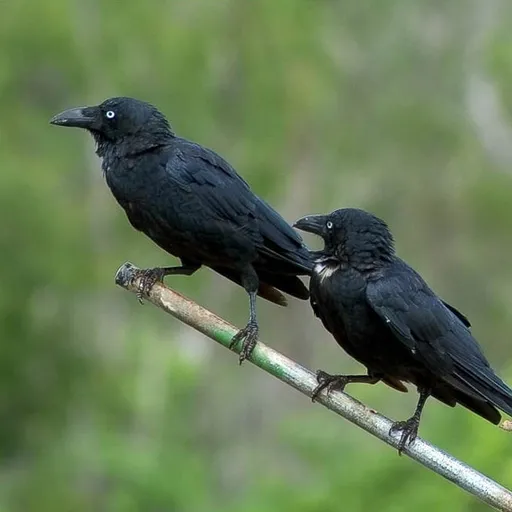
Torresian Crow
Corvus orru
Least Concern
Overview
The Torresian crow, also known as the Australian crow or Papuan crow, is a large passerine bird in the crow family native to northern and western Australia, as well as nearby islands in Indonesia and Papua New Guinea. It is an opportunistic species that has expanded its range significantly into urban and agricultural areas due to its adaptability.
Identification
- Glossy black plumage on the back, dull black on the breast, with white feather bases on the head and neck that are visible when ruffled.
- Large size (48–53 cm) with a more robust, dark grey bill and longer legs compared to the little crow.
- Distinctive white irises with a fine blue eye-ring, contrasting with juveniles that have blue eyes until about nine months of age.
- A broad tail with a distinctive square-shaped tip; birds often shuffle their wings after alighting.
Habitat
The species occupies almost any habitat within its range where a permanent source of water is available, including tropical rainforests, eucalyptus woodlands, open scrub, beaches, swamps, and offshore islands. It is well adapted to fringe habitats such as farmland, towns, and cities, where it is often the most numerous bird species in parts of Northern Australia. In arid central regions, it is confined to areas with permanent water or artificial sources like irrigation systems.
Diet
Torresian crows are omnivores that consume invertebrates, berries, carrion, roadkill, fruit, grain, and smaller animals, with urban populations relying more on anthropogenic waste. They have developed a culturally transmitted technique to kill and eat poisonous cane toads without ingesting the toxin, feeding only on the intestines and thighs. Large groups often forage nomadically across farmlands, forests, and suburbs between January and August.
Did you know?
Torresian crows have learned to bypass the deadly toxins of the introduced cane toad by flipping the amphibian onto its back to access safe parts of its body, a behaviour that is culturally transmitted within the species. They are also capable of working in teams to steal food from larger birds and can aggressively attack wedge-tailed eagles and owls to defend their nests.
Sources
- Wikipedia · CC BY-SA 4.0
- Wikidata · CC0 1.0