
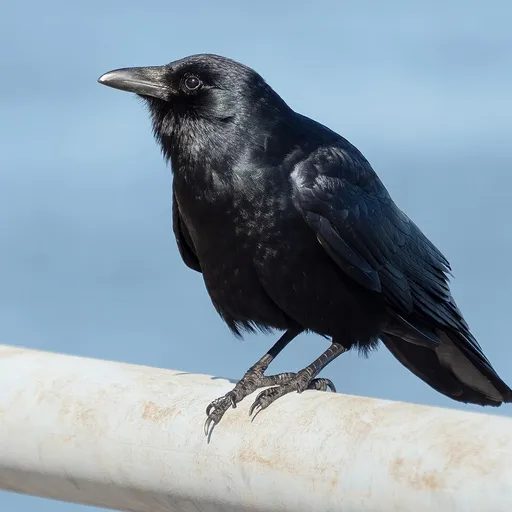
Fish Crow
Corvus ossifragus
Least Concern
Listen
XC884704 · steve · Chapel Hill, Orange County, North Carolina, United States · CC BY-SA 4.0
Overview
The fish crow (Corvus ossifragus) is a species of crow closely associated with wetland habitats in the eastern and southeastern United States. It was named by Alexander Wilson in 1812, with its scientific name meaning 'bone-breaker' and its common name reflecting its aquatic diet.
Identification
- A medium-large bird, slightly smaller than the American crow, with a wingspan of approximately 36 inches and a body length of 36–40 cm.
- Superficially similar to the American crow but possesses slimmer, silkier plumage, a narrower bill often with a small hook, and shorter legs.
- Upperparts display a blue or blue-green sheen, while underparts have a greenish tint to the black; eyes are dark brown.
- Distinctive calls described as a nasal 'ark-ark-ark' or 'waw-waw', often hunching and fluffing throat feathers while vocalising.
Habitat
The species occupies coastal marshes, beaches, rivers, inland lakes, and river banks, extending inland along river systems for considerable distances. Its range covers the eastern seaboard from Maine to Key West and the northern Gulf of Mexico coastline, with recent expansion into Canada and vagrancy to the Bahamas.
Diet
An omnivore that forages mainly from the ground or shallow water, hovering to pluck food with its feet. Its diet includes small crustaceans, stranded or live fish, invertebrates, eggs, nestlings, reptiles, tree fruits, grains, and human scraps.
Did you know?
Fish crows appear to be significantly more resistant to West Nile virus than American crows, with survival rates reported as high as 45% compared with near zero for the latter. They have also been observed raising a young blue jay for multiple weeks.
Sources
- Wikipedia · CC BY-SA 4.0
- Wikidata · CC0 1.0