
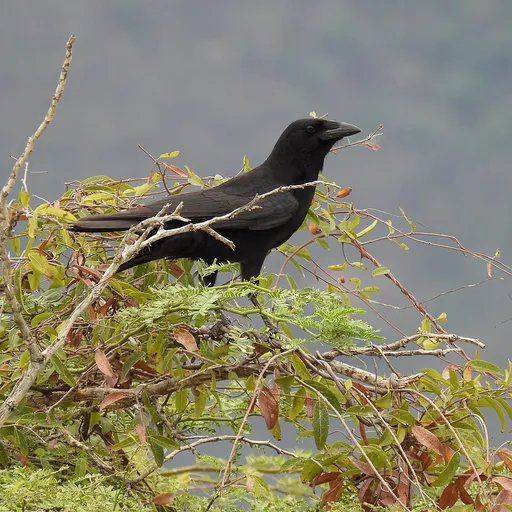
Hispaniolan Palm Crow
Corvus palmarum
Least Concern
Overview
The Hispaniolan palm crow (Corvus palmarum) is a relatively small corvid endemic to the Caribbean island of Hispaniola, which is shared by Haiti and the Dominican Republic. It is considered common in its range despite a believed decreasing population due to forest clearance and hunting.
Identification
- Adults are entirely black with strong purple-blue iridescence on the mantle and wing coverts when fresh, becoming dull brownish black when worn.
- Measures 34 to 43 cm in length and weighs approximately 229 to 258 g.
- Features a dark brown iris, a black or blackish bill, and black or blackish legs and feet.
- Vocalisations include a 'harsh, nasal aaar' and a 'double-noted cao cao', often accompanied by the bird flicking its tail downwards.
Habitat
Found in several areas in Haiti and the western half of the Dominican Republic, the species primarily inhabits pine forest in the island's mountains but also occurs in evergreen forest in the lowlands of Haiti and in dry to humid deciduous forest in both countries. It ranges from sea level to 3,000 m, though it is most common between 750 and 2,000 m in elevation.
Diet
Omnivorous, it feeds on invertebrates such as insects and snails, small vertebrates like lizards, fruits, and seeds. It typically forages in pairs or in flocks of up to about 20 individuals, utilising all levels of its habitat.
Did you know?
The species' local Spanish name, 'Cao', is derived from its distinctive double-noted 'cao cao' call. It is reputedly a delicacy and is more abundant in Haiti where gun ownership is lower.
Sources
- Wikipedia · CC BY-SA 4.0
- Wikidata · CC0 1.0