
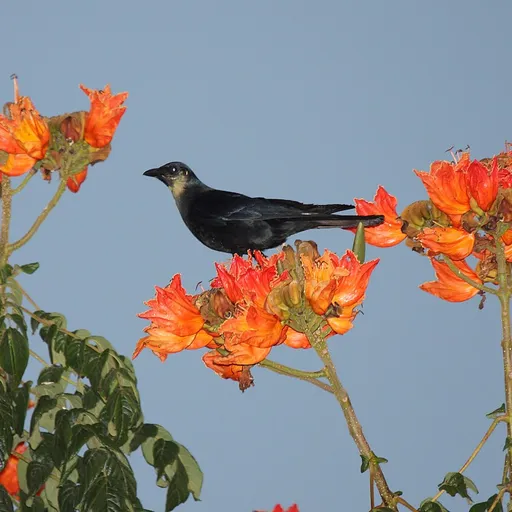
Sinaloa Crow
Corvus sinaloae
Least Concern
Overview
The Sinaloa crow (Corvus sinaloae) is a species of crow endemic to western Mexico. Once considered a subspecies or population of the Tamaulipas crow, it was recognised as a distinct species in 1958 based on its significantly different vocalisations. The species is currently classified as Least Concern by the IUCN.
Identification
- Adults display glossy dark violet plumage on the crown, nape, and secondaries, transitioning to glossy dark violet blue on the back and sides of the neck.
- Primaries and tail feathers are dark steel blue, featuring a greenish tinge on the outer primaries and a violet tinge on the central tail feathers.
- Underparts are dark steel blue or greenish steel blue, becoming more greenish towards the rear, while the head sides show similar coloration.
- Physical features include a dark brown iris, a black bill, and black legs and feet.
- The call is distinctively clear, often described as a "ceow" or a cawing "caahr" or "rraah", lacking the burry or croaking quality of the Tamaulipas crow.
Habitat
Found in western Mexico from southern Sonora south to southwestern Nayarit and east into western Durango, the species inhabits gallery forest, deciduous forest, pastures, agricultural land, and human settlements such as towns and villages. It is found at elevations ranging from sea level to approximately 1,000 m, though some sources limit the upper range to 700 m. It acts as a year-round resident in its range.
Diet
An omnivorous feeder, the Sinaloa crow is observed consuming seeds, insects, fruit, roadkill, and garbage. It forages at all levels of its habitat and is often found in pairs, small flocks, or large groups of up to 125 individuals outside the breeding season.
Did you know?
The species was only distinguished from the Tamaulipas crow in 1958 due to its vocalisation, which is so startlingly different that it suggests a considerable morphological difference in the voice-making mechanism. Despite living in tropical zones, its presence is considered to benefit from human activities such as the creation of new open habitats for agriculture and the availability of food in garbage dumps.
Sources
- Wikipedia · CC BY-SA 4.0
- Wikidata · CC0 1.0