
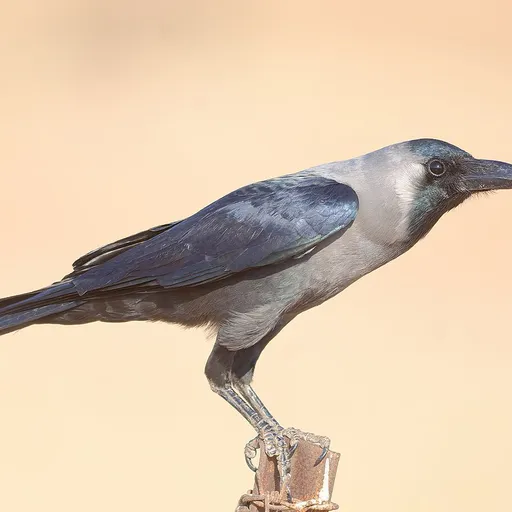
House Crow
Corvus splendens
Least Concern
Listen
XC681127 · Vihansith Kulatunga · Palaiyoothu, Trincomalee, Eastern Province, Sri Lanka · CC BY-SA 4.0
Overview
The house crow (Corvus splendens), also known as the Indian or greynecked crow, is a common bird of the crow family that is of Asian origin but now found in many parts of the world, where they arrived assisted by shipping. It is classified as Least Concern on the IUCN Red List due to its widespread distribution and adaptability to human environments.
Identification
- Length is between that of a jackdaw and a carrion crow (40 cm) but the bird is slimmer than either.
- Forehead, crown, throat and upper breast are a richly glossed black, whilst the neck and breast are a lighter grey-brown.
- Wings, tail and legs are black, with regional variations in bill thickness and plumage colour depth.
- The voice is harsh and usually represented by the onomatopoeia "kaaw-kaaw".
Habitat
Native to southern Asia, including Nepal, Bangladesh, India, Pakistan, Sri Lanka, Maldives and Laccadive Islands, southern Myanmar, south Thailand, and coastal southern Iran. It has also been introduced to parts of East Africa, Australia, Europe, and the New World. The species is strongly associated with human settlements, ranging from small villages to large cities, and cannot currently sustain populations independently of human activity.
Diet
Being an omnivorous scavenger, house crows feed largely on refuse around human habitations, small reptiles, mammals, insects, eggs, nestlings, grain and fruits. Most food is taken from the ground, but they also forage from trees as opportunity arises, and are often seen near marketplaces and garbage dumps. They have even been observed eating sand after feeding on carcasses.
Did you know?
The house crow is currently the only known corvid species with the ability to successfully perform the mirror-mark test used for identifying self-recognition behaviour in animals in a laboratory setting.
Sources
- Wikipedia · CC BY-SA 4.0
- Wikidata · CC0 1.0