
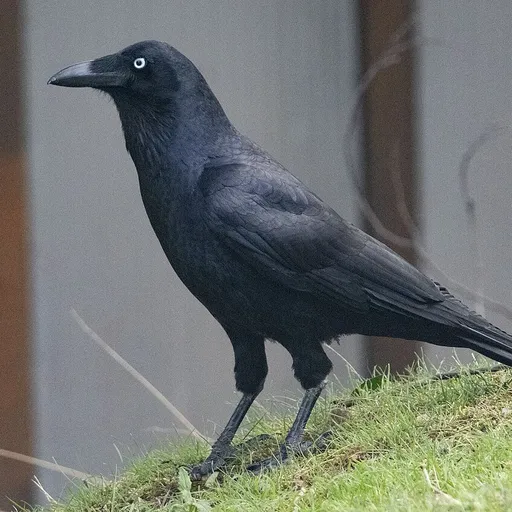
Forest Raven
Corvus tasmanicus
Least Concern
Overview
The forest raven (Corvus tasmanicus), also known as the Tasmanian raven, is a passerine bird native to Tasmania and parts of southern Australia. It is the largest of the Australian corvids and is listed as Least Concern on the IUCN Red List. The species is sedentary and forms monogamous pairs that establish permanent territories.
Identification
- Plumage: Entirely glossy black with a blue or green sheen on the upperparts; feather bases are grey but generally not visible in the field.
- Size: Large and stocky, measuring 50–53 cm in length with a wingspan of 91–113 cm.
- Bill: Massive and heavy-set, with the upper mandible covered in bristles.
- Vocalisation: A deep, husky "korr-korr-korr-korr" call, which is considered the most reliable means of identification where ranges overlap with other corvids.
Habitat
In Tasmania, the forest raven inhabits a wide variety of environments, including woods, open forest, mountains, coastal areas, farmland, and urban fringes. On mainland Australia, its range is more restricted to closed forest habitats such as wet and dry sclerophyll forest, cool temperate rainforest, and pine plantations. Populations are found in Tasmania, southern Victoria, and isolated areas of New South Wales, and the species has colonised islands in Bass Strait.
Diet
An omnivorous and opportunistic feeder, the forest raven consumes a wide range of plant and animal material, including insects, carrion, fruit, grain, and earthworms. It frequently forages near water, gleaning from sand and turning over debris to find insects, and will raid seabird colonies for eggs and young. The species is also attracted to human waste, often foraging at rubbish tips, picnic grounds, and roadsides.
Did you know?
Although generally sedentary, forest ravens have been recorded flying from the mainland and Tasmania to islands well offshore in Bass Strait and may even traverse the strait entirely. They have established significant populations on King Island, where flocks of several hundred birds were recorded by 1997, replacing the previously resident little ravens.
Sources
- Wikipedia · CC BY-SA 4.0
- Wikidata · CC0 1.0