
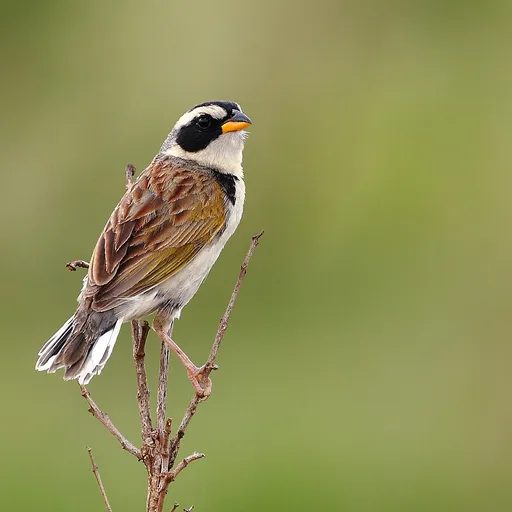
Black-masked Finch
Coryphaspiza melanotis
Vulnerable
Overview
The black-masked finch (Coryphaspiza melanotis) is a Vulnerable bird species within the tanager family, Thraupidae. It is a year-round resident with a disjunct distribution across South America.
Identification
- Approximately 13.5 cm long with a stout, thick-based bill featuring a black maxilla and bright yellow mandible.
- Adults possess a black forehead and crown, a long white supercilium, and a large triangular black mask extending to the grayish nape.
- Underparts are white with a black spur on the side of the breast and blackish flank patches; the upperwing is greenish with yellow marginal coverts.
- The song is high-pitched and insect-like, described as paired notes sounding like 'tziieeep' repeated every two seconds.
Habitat
The species inhabits tall and tussock grasslands with minimal shrubs, ranging from near sea level to 1,200 m. Its range spans from southeastern Peru and northern Bolivia across western Brazil into Paraguay and extreme northeastern Argentina, with a separate population on Marajó Island in the Amazon Delta.
Diet
The specific diet of the black-masked finch is not known, though it typically forages in pairs during the breeding season and in flocks otherwise. Foraging usually takes place under the grass, but the bird sometimes forages on bare soil.
Did you know?
The genus name Coryphaspiza combines the Ancient Greek for 'crown of the head' with 'finch', while the specific epithet melanotis translates to 'black-eared'.
Sources
- Wikipedia · CC BY-SA 4.0
- Wikidata · CC0 1.0