
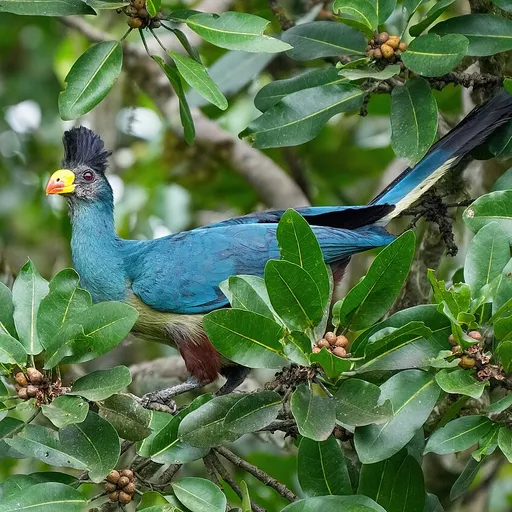
Great Blue Turaco
Corythaeola cristata
Least Concern
Listen
XC781312 · paulo kivuyo · Minziro, Bukoba Rural, Kagera Region, Tanzania · CC BY-SA 4.0
Overview
The great blue turaco, Corythaeola cristata, is the largest species of turaco within the family Musophagidae. It is a widely distributed bird found across the African tropical rainforest. The species is currently listed as Least Concern on the IUCN Red List.
Identification
- Predominantly grey-blue plumage featuring an upright blue-black crest approximately 10 cm high.
- Large size, ranging from 70–76 cm in length, with a mass between 800–1,231 g.
- Yellow bill with a distinct orange-red tip and brown eyes surrounded by a ring of black bare skin.
- Yellow-green lower breast transitioning to a yellow belly that darkens to chestnut brown, with black legs and feet having yellow soles.
Habitat
It inhabits rainforests and gallery forests across sub-Saharan Africa, ranging from Guinea in the west to the Imatong Mountains in South Sudan, and south to the Democratic Republic of Congo and Angola. The species has also adapted to areas cleared by humans, where it can thrive.
Diet
The great blue turaco feeds on leaves, flowers, and fruit from numerous plant species, including Ficus, Musanga, and Cordia africana. Leaves constitute around 25% of its diet, particularly when fruit is scarce. It plays a significant role in seed dispersal, passing seeds in its faeces some distance from parent trees.
Did you know?
The Mbuti people of the Ituri Rainforest believe that the great blue turaco is associated with okapis, serving to warn them of danger by calling loudly. They also hold the belief that eating this bird while pregnant may result in a difficult delivery or birth deformity.
Sources
- Wikipedia · CC BY-SA 4.0
- Wikidata · CC0 1.0