
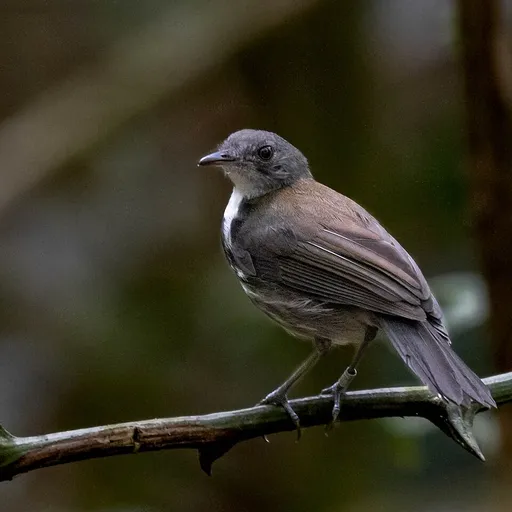
Ringed Antpipit
Corythopis torquatus
Least Concern
Overview
The ringed antpipit (Corythopis torquatus) is a species of bird in the family Tyrannidae. It is found in every mainland South American country except Argentina, Chile, Paraguay, and Uruguay, and is currently assessed as Least Concern by the IUCN.
Identification
- A small bird, 13.5 to 14 cm long, with an almost solid black 'necklace' on a white breast, giving the species its English name.
- Upperparts, wings, and tail are dark brownish olive, while the crown ranges from grayish brown to slate-gray depending on the subspecies.
- Features a faint whitish loral spot and a spot behind the eye on a pale grayish olive face, with black streaks extending from the breast along the flanks.
- Possesses a blackish maxilla, a pale pinkish mandible with a yellow to pinkish orange base, and long pale gray to pinkish gray legs.
Habitat
Primarily a bird of the Amazon Basin, also occurring in the Orinoco Basin, it inhabits humid evergreen forest in the tropical zone. It favours terra firme, seasonally flooded forest, and swamp forest, and less frequently mid-successional forest along rivers. Elevation varies by region, generally occurring below 1,000 m but locally reaching up to 1,500 m in Peru.
Diet
The ringed antpipit feeds primarily on arthropods and occasionally includes lizards and frogs in its diet. It usually forages alone or in pairs, walking slowly on the forest floor and along downed logs while bobbing its head and tail. Prey is mostly taken by jumping up to snatch it from the underside of leaves with an audible snap of the bill.
Did you know?
The species constructs a large oven-shaped dome nest made of moss, lined with thin plant fibers and fungal rhizomorphs. Its song is notably variable, which is unusual for a member of the flycatcher family.
Sources
- Wikipedia · CC BY-SA 4.0
- Wikidata · CC0 1.0