
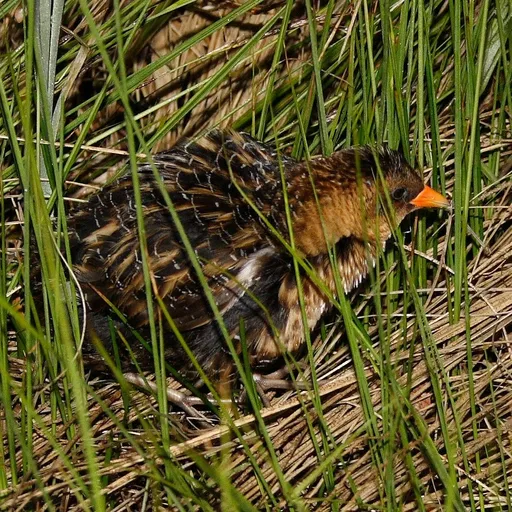
Yellow Rail
Coturnicops noveboracensis
Least Concern
Listen
XC344711 · Peter Wilton · Swamp Lake, Leech Lake Township (near Walker), Cass County, Minnesota, United States · CC BY-SA 4.0
Overview
The yellow rail (Coturnicops noveboracensis) is a small, secretive marsh bird found across North America. It belongs to the family Rallidae and is currently classified as Least Concern on the IUCN Red List, though its numbers have declined in recent years due to habitat loss.
Identification
- Adults have brown upperparts streaked with black, a yellowish-brown breast, and a light belly with barred flanks.
- The short, thick dark bill turns yellow in males during the breeding season.
- Birds measure 16–19 cm in length, with greenish-yellow legs and a yellow-brown band over the eye.
- They call at night with a sound resembling two stones clicked together, described as "tik-tik tik-tik-tik".
Habitat
Breeding habitats include wet meadows, fens, and shallow marshes across eastern Canada and the northeastern United States. Northern populations migrate to the southeastern coastal United States, overwintering in wet pine savanna habitats along the northern Gulf Coast region.
Diet
The yellow rail feeds primarily on small invertebrates, with beetles, spiders, and snails making up the highest proportion of its diet. It complements this animal matter with plant seeds, particularly from sedges and rushes.
Did you know?
When approached, these birds are more likely to rely on camouflage and escape on foot through dense vegetation rather than flushing into flight. A 2021 survey in a protected area 150 kilometres outside the species' known range estimated a population of 906 breeding pairs, suggesting they may be more widespread than previously thought.
Sources
- Wikipedia · CC BY-SA 4.0
- Wikidata · CC0 1.0