
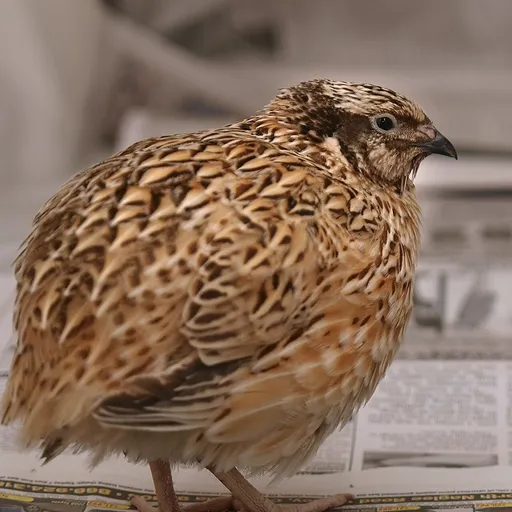
Japanese Quail
Coturnix japonica
Near Threatened
Listen
XC753225 · Oriental Stork · 大宁水库及其东部永定河废弃河道,Beijing,China, China · CC0 1.0
Overview
The Japanese quail, also known as the coturnix quail, is a species of Old World quail found primarily in East Asia. Though formerly considered a subspecies of the common quail, it is now recognised as a distinct, monotypic species that has played a significant role in human industry and scientific research since the 12th century.
Identification
- Adult plumage is sexually dimorphic, with males displaying uniform dark reddish-brown breast feathers and rufous cheeks, while females feature pale feathers with dark spots and cream-coloured cheeks.
- Males may exhibit a white collar and possess distinctive rufous throat feathers during the breeding season that are replaced by long pale feathers in non-breeding seasons.
- Wild adults typically weigh between 90 and 100 grams, with males generally smaller than females.
- The typical crow consists of two short parts preceding a final, major trill, with call types varying between sexes and contexts.
Habitat
Populations mainly inhabit East Asia and Russia, including India, Korea, Japan, and China, with many individuals migrating south to Vietnam, Cambodia, Laos, and southern China for the winter. The species is primarily ground-living, favouring areas of dense vegetation such as grassy fields, riverbank bushes, and agricultural fields planted with oats, rice, or barley, as well as open steppes and meadows near water sources.
Diet
The Japanese quail feeds on a variety of grass seeds, such as white millet and panicum, along with insects, their larvae, and other small invertebrates. Foraging and drinking behaviour closely follows the photoperiod, with peak activity at the beginning and end of the day, though feeding continues throughout the day.
Did you know?
Japanese quail eggs have been successfully incubated and hatched in outer space aboard the Bion 5 satellite and the Salyut 6 and Mir space stations, with one experiment achieving an 82 percent hatchability rate identical to earth-based controls.
Sources
- Wikipedia · CC BY-SA 4.0
- Wikidata · CC0 1.0