
Hooded Butcherbird
Cracticus cassicus
Least Concern
Overview
The hooded butcherbird (Cracticus cassicus) is a species of passerine bird in the family Artamidae, found exclusively in New Guinea. It is a carnivorous bird that typically inhabits subtropical or tropical moist lowland forests.
Identification
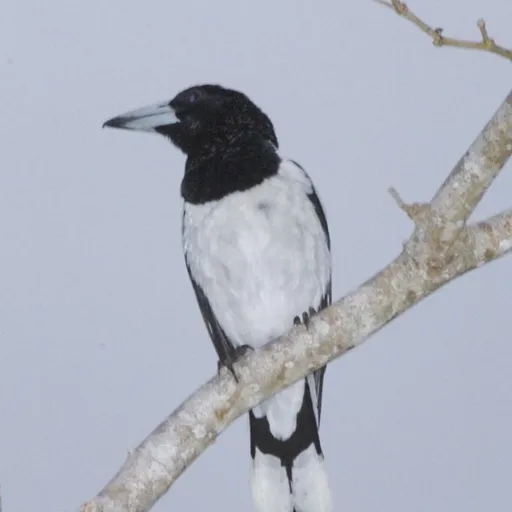
- Predominantly black and white plumage with a black head, nape, and throat contrasting with white underparts, rump, and back.
- A robust, hooked, pale bluish-grey bill tipped with black, accompanied by dark grey to black legs and feet.
- Distinguished from the similar black-backed butcherbird by its black throat.
- Produces a complex fluting song composed of varied components, often involving duetting or the mimicry of species such as the rusty pitohui and spangled drongo.
Habitat
Native to New Guinea and surrounding islands, this species occupies forested country mainly in lowland areas up to 650 m elevation, though it can occasionally be found at heights of 1450 m. It is fairly common and may also inhabit coconut groves close to human habitation.
Diet
The hooded butcherbird is carnivorous and forages in pairs or small family groups. Specific details regarding prey items are not provided in the reference material.
Did you know?
The generic name Cracticus derives from the Ancient Greek word meaning 'noisy' or 'clamorous', reflecting the bird's vocal nature. Its specific epithet cassicus originates from the French word 'Cassique', which was used for orioles.
Sources
- Wikipedia · CC BY-SA 4.0
- Wikidata · CC0 1.0