
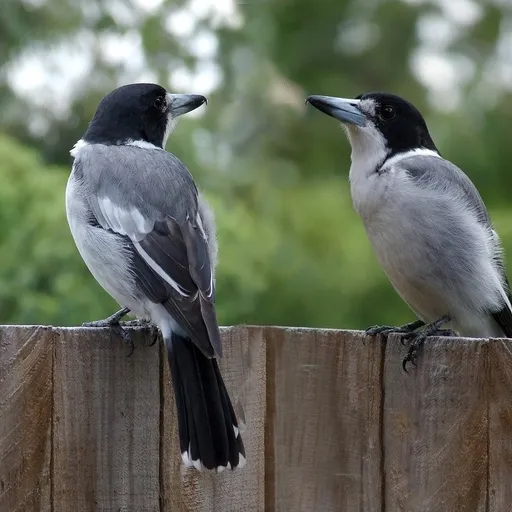
Grey Butcherbird
Cracticus torquatus
Least Concern
Listen
XC1051773 · James Ray · Highgate Hill, Brisbane City, Queensland, Australia · CC BY-SA 4.0
Overview
The grey butcherbird (Cracticus torquatus) is a widely distributed songbird endemic to Australia. It is characterised by its adaptable nature, thriving in both natural and urban environments across the continent.
Identification
- Plumage: Small grey, black and white bird; adults have a black head, dark grey upperbody with white streaks, and a white chin and throat.
- Size: Body length of 27–30 cm with a wingspan of 37–43 cm, weighing approximately 90 grams.
- Bill: Features a slight downward hook at the tip.
- Song: A loud, rollicking territorial song with musical and harsh elements, often performed in duet or group and lasting up to 15 minutes.
Habitat
Found across southern Australia, excluding the deserts of central Australia and the monsoon tropics of the north. It inhabits diverse environments including arid and temperate zones, eucalypt forests, mallee shrublands, and urban suburbs of major cities like Sydney and Melbourne.
Diet
Feeds primarily on invertebrates, especially insects, but also preys on small vertebrates such as other birds, nestlings, and lizards, with occasional consumption of fruit and seeds. Foraging involves sally-pouncing or ambush from a perch, and the bird exhibits a habit of storing excess food in branch forks.
Did you know?
Grey butcherbirds have a notable habit of caching food by impaling it on thorns or storing it in the fork of a branch to be consumed later. Juvenile grey butcherbirds are commonly mistaken for small kingfishers due to their different plumage patterns.
Sources
- Wikipedia · CC BY-SA 4.0
- Wikidata · CC0 1.0