
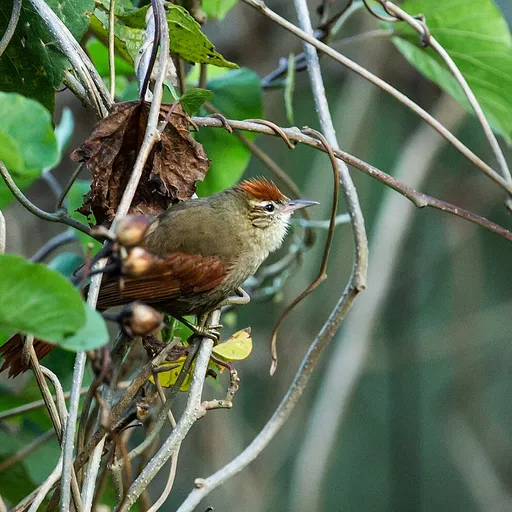
Line-cheeked Spinetail
Cranioleuca antisiensis
Least Concern
Listen
XC250064 · Niels Krabbe · Azuay: se-slope Cerro Quillotuñi, Ecuador · CC BY-SA 4.0
Overview
The line-cheeked spinetail (Cranioleuca antisiensis) is an arboreal species of bird in the ovenbird family Furnariidae. It is a common species found in the Andes of Ecuador and Peru, with an IUCN conservation status of Least Concern.
Identification
- Mid-sized bird measuring 14.5 cm in length and weighing 15–18 g, featuring a long, graduated tail and a relatively long bill that curves slightly downward.
- Plumage consists of a rufous crown, a well-defined white supercilium, a pale throat, and streaked ear coverts; the upperparts are brown to olive-grey, while the breast and belly are greyish-brown with rufous tail and wings.
- Song includes a series of loud shrills usually ending in a trill before fading, accompanied by chippering and scolding calls such as a "tsi-chik".
Habitat
This species occupies a clinal distribution along the western slope of the Andes in south-west Ecuador and western Peru, primarily inhabiting subtropical or tropical moist montane forests, woodland, and scrub. It prefers semi-humid to humid habitats with dense evergreen vegetation rather than cloud forests, occurring at elevations ranging from 800 m in Ecuador to a maximum of 3000 m, though limited to around 2000 m in the more arid regions of Peru.
Diet
Like other members of the family Furnariidae, line-cheeked spinetails are insectivores, though their exact diet has not been fully studied. They primarily forage by gleaning near the ground and within shrubs, although they will often move up into the canopy to find food.
Did you know?
The majority of species within the genus Cranioleuca diverged relatively recently in a rapid speciation event beginning approximately 3.5 million years ago, a process potentially driven by rapid changes in plumage that facilitated reproductive isolation.
Sources
- Wikipedia · CC BY-SA 4.0
- Wikidata · CC0 1.0