
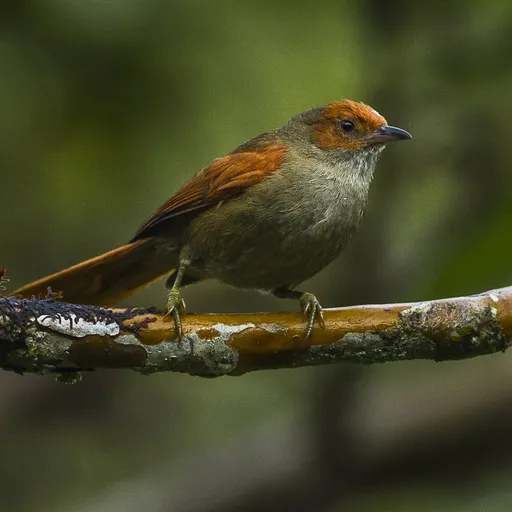
Red-faced Spinetail
Cranioleuca erythrops
Least Concern
Listen
XC248553 · Niels Krabbe · Pichincha: ridge between Río Mindo and Río Nambillo, 3 km SE Mindo, Ecuador · CC BY-SA 4.0
Overview
The red-faced spinetail (Cranioleuca erythrops) is a species of bird in the ovenbird family Furnariidae, found across parts of Central and South America. It is classified as Least Concern on the IUCN Red List, with an estimated population of at least 50,000 mature individuals.
Identification
- Cranioleuca erythrops measures 14 to 15 cm in length and weighs between 13 and 20 g.
- Adults of the nominate subspecies feature a rufous face and crown, rich olive-brown nape and back, and a reddish chestnut tail with a spiny appearance.
- The species produces a high-pitched, fast, scratchy chatter-trill described as 'seet-seet-seet-se-e-e-e-e-e-e-e' or 'ukukuk-ikikikikik'.
Habitat
This bird inhabits lower to mid-elevation subtropical montane forests and woodlands, including mature secondary forest, with specific elevations ranging from 700 m to 2,300 m depending on the country.
It is found in the mountains of Costa Rica, Panama, the Andes of Colombia and Ecuador, and the Cordillera de Mache in coastal Ecuador.
Diet
The red-faced spinetail feeds mostly on arthropods but also consumes protein corpuscles from Cecropia trees.
It forages singly or in pairs, often joining mixed-species flocks, and gleans prey from bark, moss, and debris by hitching along small branches or hanging upside down.
Did you know?
The nest is decorated with bits of grass dangling above and below to break its shape, acting as a camouflage or 'masquerade' to make it resemble random debris and protect it from predators.
Sources
- Wikipedia · CC BY-SA 4.0
- Wikidata · CC0 1.0