
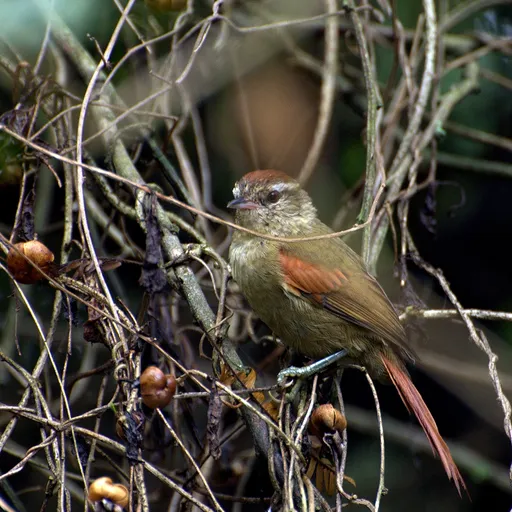
Pallid Spinetail
Cranioleuca pallida
Least Concern
Overview
The pallid spinetail (Cranioleuca pallida) is a small ovenbird endemic to Brazil, belonging to the Furnariidae family. It is classified as a species of Least Concern by the IUCN, although its population is believed to be decreasing due to habitat loss.
Identification
- Smallish bird measuring 14 to 15 cm in length, with a dark rufous crown and tawny-olive back.
- Features a wide whitish supercilium, a blackish spot in front of the eye, and buffy ear coverts.
- Tail is dark rufous with graduated feathers that appear spiky due to lacking barbs at the ends.
- Song consists of a high, slightly descending series of 'seetseet---tut' notes, often accelerating into a trill; calls are described as 'tééé-ssik, tséé-ssik'.
Habitat
This species inhabits montane evergreen forest, woodlands, and mature secondary forest in southeastern Brazil, ranging from southern Goiás and central Minas Gerais to eastern Paraná. It occurs at elevations between 700 and 2,150 m.
Diet
The pallid spinetail feeds on arthropods, typically foraging in pairs or joining mixed-species flocks. It forages acrobatically, gleaning prey from vines, dead leaves, bark, and flowers while hitching and climbing along small branches in the forest mid-storey and canopy.
Did you know?
The bird constructs its nest as a globe of lichen and moss with a side entrance, typically placed on a tree branch against the trunk or atop a clump of epiphytes.
Sources
- Wikipedia · CC BY-SA 4.0
- Wikidata · CC0 1.0