
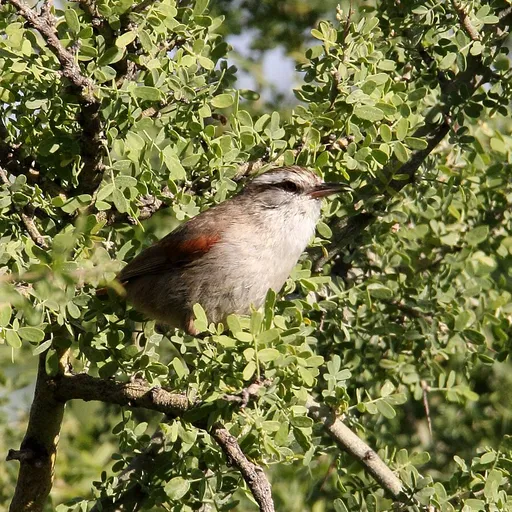
Stripe-crowned Spinetail
Cranioleuca pyrrhophia
Least Concern
Overview
The stripe-crowned spinetail (Cranioleuca pyrrhophia) is a small ovenbird in the Furnariidae family, characterised by its unique crown and tail patterns. It is classified as Least Concern by the IUCN and is found across several South American countries.
Identification
- Length 13 to 16 cm with a weight of 10 to 16 g, featuring a dramatically striped crown in blackish and buffy brown that is fainter in southern regions.
- The tail is graduated and very pointed, creating a forked appearance with rufous central feathers and outer pairs.
- Legs and feet are olive-green to greenish grey or yellowish brown, while the bill is pinkish horn with a dark tip.
- Vocalisations include an accelerating, descending trill without introductory notes and metallic 'tick' notes followed by rapid, high, descending 'chack' clicks.
Habitat
This species inhabits diverse landscapes ranging from tropical deciduous forest and gallery forest to arid montane scrublands and dry savanna. It occupies elevations from near sea level up to 3,100 m, including Alnus and Podocarpus woodlands in the Andes. Its range covers Argentina, Bolivia, Brazil, Paraguay, and Uruguay, where it is a year-round resident.
Diet
The stripe-crowned spinetail feeds on arthropods, typically foraging singly or in pairs, and frequently joins mixed-species feeding flocks. It acrobatically gleans prey from bark, lichens, mosses, and epiphytes while hitching and climbing along small branches from the understory to the canopy.
Did you know?
The nominate subspecies is the southernmost representative of the genus Cranioleuca, yet the entire species is tolerant of habitat disturbance and is often found in agricultural regions with only small patches of habitat remaining. Subspecies C. p. rufipennis has not been definitely recorded for at least 50 years and may be endangered.
Sources
- Wikipedia · CC BY-SA 4.0
- Wikidata · CC0 1.0