
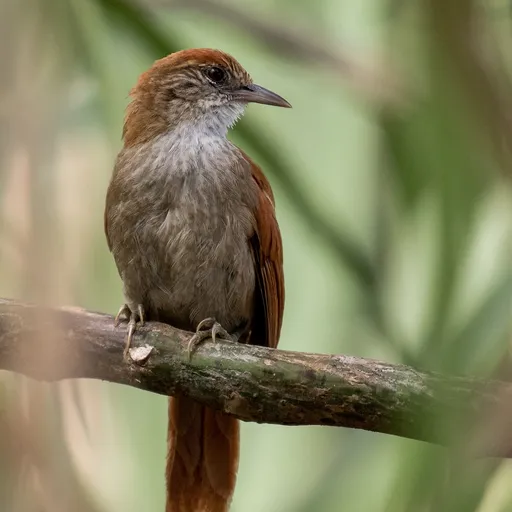
Parker's Spinetail
Cranioleuca vulpecula
Least Concern
Listen
XC248785 · Niels Krabbe · Orellana: river island at Añangu, Ecuador · CC BY-SA 4.0
Overview
Parker's spinetail (Cranioleuca vulpecula) is a species of bird in the ovenbird family Furnariidae. It is found in the upper Amazon basin across Bolivia, Brazil, Ecuador, and Peru. The species is classified as Least Concern by the IUCN, with a stable population and no immediate threats.
Identification
- Adults possess a dusky gray face with a faint buff supercilium and lores, contrasting with a rufous crown, back, rump, wings, and tail.
- The forecrown features narrow buff streaks, while the throat is white and the rest of the underparts are light brown or grayish with indistinct whitish mottling.
- Males and females share the same plumage, though juveniles have a duller crown.
- The bird measures 13 to 16 cm in length and weighs between 16 and 20 g, with a black maxilla and pale grayish-pink mandible.
- Its song is an accelerating and descending series of nasal notes that ends in a chortle, described as 'tew-tew-tew-tew-trrrrrr'.
Habitat
This species inhabits early-succession vegetation on young river islands along the upper Amazon River and its major tributaries. Its range extends from eastern Ecuador and northeastern Peru through far northern Bolivia into western Brazil as far east as the Rio Negro. It is typically found at elevations below 300 m, although it can reach 400 m in Ecuador.
Diet
Parker's spinetail feeds primarily on arthropods, foraging in the under- and mid-storeys of woody vegetation usually in pairs. It gleans prey from bark, dead leaf clusters, and trapped debris while searching along trunks and limbs.
Did you know?
While human activity generally has little short-term direct effect, this species may actually benefit locally from human activities such as low-level clearing for subsistence agriculture, as it occupies disturbed habitats.
Sources
- Wikipedia · CC BY-SA 4.0
- Wikidata · CC0 1.0