
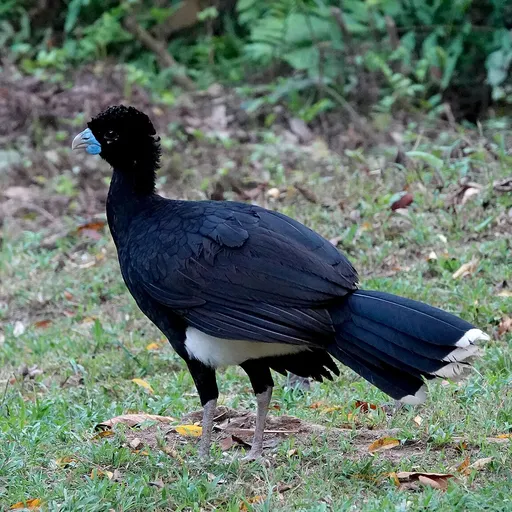
Blue-billed Curassow
Crax alberti
Critically Endangered
Overview
The blue-billed curassow (Crax alberti) is a large, ground-dwelling bird in the family Cracidae that is endemic to Colombia. It is currently classified as Critically Endangered by the IUCN, with its population fragmented and decreasing due to habitat loss and hunting.
Identification
- Large bird measuring 82.5 to 92.5 cm in length and weighing 3.2 to 3.6 kg, with an erectile crest that is black in males and black-and-white in females.
- Distinguished by a blue cere and wattle on the male, which is the only curassow species with these features.
- Plumage is mostly black with fine white barring on the wings and tail; males have a white vent and tail tip, while females have a rufous lower belly and vent.
- Males produce a deep, 4–5-syllable booming call described as 'hmm...hmh...hmm...hmm...hmh', while both sexes emit a soft, high-pitched whistle when alarmed.
Habitat
Found only in northern Colombia, inhabiting undisturbed forest in tropical and upper tropical zones, typically from near sea level up to 600 m, though formerly reaching 1,200 m. Its range has shrunk from 106,700 km² to approximately 2,090 km², with the last viable population located in the Serranía de las Quinchas area of the Magdalena Valley.
Diet
This species forages mainly on the ground, feeding on fruits, worms, and insects. It also ingests sand and small stones to aid in digestion.
Did you know?
The blue-billed curassow builds a large nest from sticks and dead leaves, concealing it within dense vine tangles between the understory and subcanopy. Its eggs hatch after 32 days of incubation, emerging full-feathered.
Sources
- Wikipedia · CC BY-SA 4.0
- Wikidata · CC0 1.0