
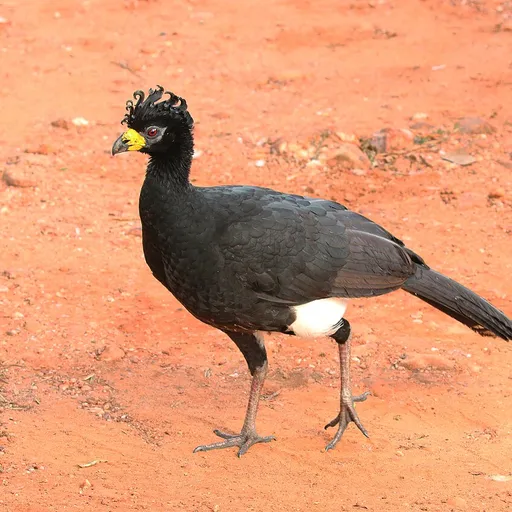
Bare-faced Curassow
Crax fasciolata
Vulnerable
Overview
The bare-faced curassow (Crax fasciolata) is a large bird species in the family Cracidae. It is found in Brazil, Paraguay, eastern Bolivia, and extreme northeast Argentina. The species is currently classified as Vulnerable on the IUCN Red List due to habitat destruction and hunting.
Identification
- Length of 82 to 92 centimetres (32 to 36 in).
- Males have black upper parts faintly glossed with greenish-olive, white underparts, and an unfeathered face with yellowish bare skin.
- Females have a black head, throat, and neck, with a black and white barred crest and blackish facial skin.
- Both sexes feature a black tail tipped with white or ochre.
Habitat
Found in the cerrado, pantanal, and the southeastern region of the Amazon basin, the species inhabits subtropical or tropical dry forest and subtropical or tropical moist lowland forest. It lives in moist, semi-deciduous, and gallery forests, often near the fringes of the woodland.
Diet
The bare-faced curassow mainly feeds on fruit, but also eats seeds, flowers, and small invertebrates.
Did you know?
The total population is likely declining quite rapidly, despite the species being fairly numerous in parts of its range, due to subjectivity to hunting and habitat destruction.
Sources
- Wikipedia · CC BY-SA 4.0
- Wikidata · CC0 1.0