
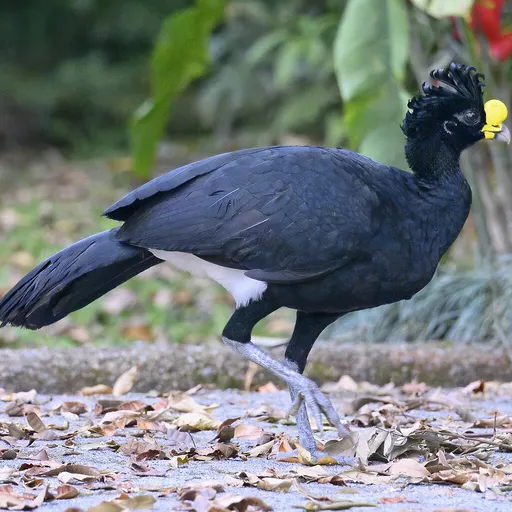
Great Curassow
Crax rubra
Vulnerable
Overview
The great curassow (Crax rubra) is a large, pheasant-like bird native to Neotropical rainforests. It is classified as Vulnerable on the IUCN Red List due to habitat loss and hunting pressures.
Identification
- Males are black with a curly crest, a white belly, and a distinctive yellow knob on the bill.
- Females exhibit three plumage morphs: barred, rufous (reddish-brown with a barred tail), or dark (blackish neck, mantle, and tail with some wing barring).
- This is a very large and heavy cracid, ranging from 78–100 cm in length and 3.1–4.8 kg in weight.
- The voice resembles other curassows, characterized by a 'peculiar' lingering whistle.
Habitat
The great curassow inhabits Neotropical rainforests across a range extending from eastern Mexico through Central America to western Colombia and northwestern Ecuador. It is the most northerly species within the genus Crax.
Diet
The bird forages mainly on the ground for fruits, figs, and arthropods, occasionally supplementing its diet with small vertebrates such as rodents. Unlike other cracids, it feeds largely on fallen fruit rather than plucking directly from trees.
Did you know?
Great curassows can produce fertile hybrids with both their closest living relative, the blue-billed curassow, and the much more distantly related black curassow.
Sources
- Wikipedia · CC BY-SA 4.0
- Wikidata · CC0 1.0