
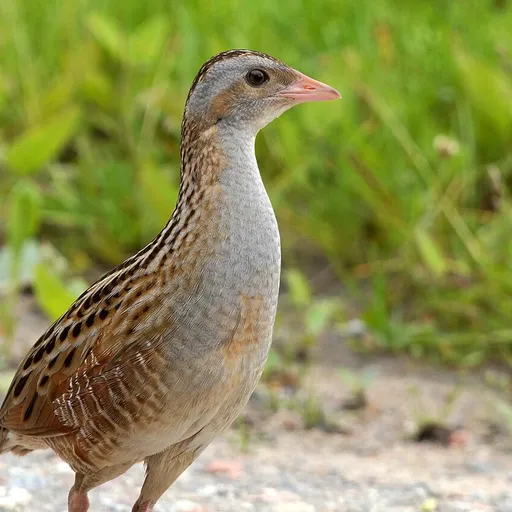
Corn Crake
Crex crex
Least Concern
Listen
XC1079962 · Sonothèque ADVL · Vains, Manche, Normandie, France · CC0 1.0
Overview
The corn crake, also known as the corncrake or landrail (Crex crex), is a medium-sized bird in the rail family that breeds across Europe and Asia before migrating to Africa for the winter. Although classed as Least Concern by the IUCN due to stable populations in Russia and Kazakhstan, the species is in steep decline across much of its former breeding range in western Europe owing to modern farming practices.
Identification
- Medium-sized rail measuring 27–30 cm in length with a wingspan of 42–53 cm.
- Brownish-black upperparts streaked with buff or grey, featuring distinctive chestnut markings on the wings and blue-grey underparts with rust-coloured and white bars on the flanks.
- Strong, flesh-toned bill, pale brown iris, and pale grey legs and feet.
- Loud, repetitive, and grating 'krek krek' call from the male, which can be heard from up to 1.5 km away.
- In flight, shows longer, less rounded wings than the African crake, with a white leading edge to the inner wing and dangling legs.
Habitat
This species breeds primarily in cool, moist grassland, particularly hayfields, and migrates to dry grassland and savanna habitats in Africa. It occupies lowland environments but can breed at altitudes up to 3,000 m in Russia, avoiding very wet habitats, open areas, and vegetation over 50 cm tall or too dense to walk through.
Diet
The corn crake is omnivorous but mainly feeds on invertebrates, occasionally consuming small frogs or mammals, as well as plant material such as grass seed and cereal grain.
Did you know?
The species' scientific name, Crex crex, is onomatopoeic, derived from the ancient Greek word for the bird's repetitive grating call, which can be reproduced mechanically by rubbing two pieces of notched wood together or flicking a credit card against a comb.
Sources
- Wikipedia · CC BY-SA 4.0
- Wikidata · CC0 1.0