
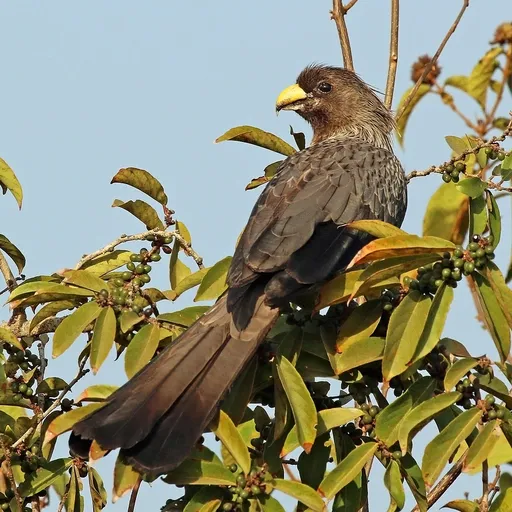
Western Plantain-eater
Crinifer piscator
Least Concern
Overview
The western plantain-eater (Crinifer piscator), also known as the grey plantain-eater, is a large member of the turaco family restricted to Africa. It is a resident breeder in open woodland habitats across tropical west Africa, where it is classified as Least Concern on the IUCN Red List.
Identification
- Approximately 50 cm in length including a long tail, with plumage that is mainly grey above and spotted with brown.
- Features a brown, silver-streaked head with an erectile crest, neck, and breast, while the underparts are whitish and heavily streaked with brown.
- Possesses a thick, bright yellow bill and displays a white wing bar in flight; juveniles differ by having a black woolly head without silver streaking.
- Produces a loud cow-cow-cow call that is described as very familiar in the region.
Habitat
This species is a resident breeder in open woodland habitats within tropical west Africa. It constructs tree platform nests in which it lays two or three eggs.
Diet
The bird feeds primarily on fruit, with a particular preference for figs, as well as seeds and other vegetable matter.
Did you know?
The specific name piscator is Latin for 'fisherman', yet the bird has no connection to fishing as it subsists on fruit and seeds. The name originated when Pieter Boddaert coined the binomial Falco piscator in 1783, based on an illustration that was later questioned by ornithologist James L. Peters.
Sources
- Wikipedia · CC BY-SA 4.0
- Wikidata · CC0 1.0