
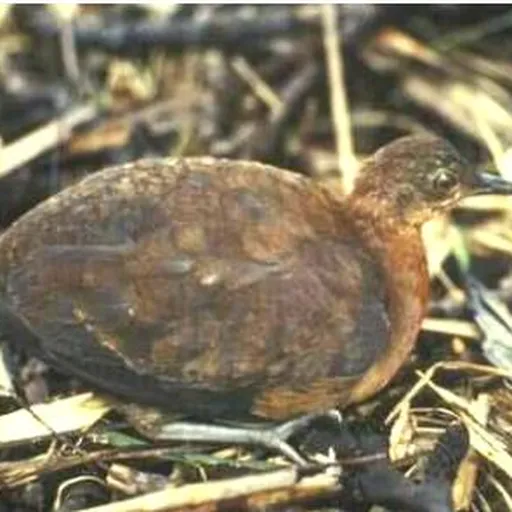
Grey-legged Tinamou
Crypturellus duidae
Least Concern
Overview
The grey-legged tinamou, Crypturellus duidae, is a small, ground-dwelling bird endemic to the neotropics. It is a rare sight in the wild, owing to its small size and discreet appearance.
Identification
- Body length ranges from 28 to 31 cm, featuring a rusty coloured neck and upper back with a tinge of grey on the upper breast.
- The wings and body are a scaly brownish black, while the legs are a distinctive slate grey.
- Males possess a prominent dark crown of feathers on the top of the head, whereas females have a fully rusty coloured head and markings on their backs and wings.
- The call is a short, hollow-sounding two-syllable whistle, described as “whoo-whoooooooo” with a slight rise near the end, lasting 2-3 seconds.
Habitat
Native to South America, including Colombia, Peru, Ecuador, Guyana, Venezuela, and northern Brazil, the species is sparsely distributed in fragmented landscapes. It inhabits dry shrubland up to 500 m in altitude and is commonly found in Amazonian white-sand forests characterised by low-hanging canopies and dense foliage, as well as peatland habitats.
Diet
The grey-legged tinamou primarily consumes fruits and other plant matter, feeding on low-hanging or fallen fruit. It forages on the ground and in low bushes, and has also been documented consuming insects and other ground-dwelling invertebrates.
Did you know?
Although historically considered distinct from ratites due to their ability to fly, genetic evidence suggests tinamous are close relatives of the giant flightless moas, implying that flightlessness evolved independently multiple times within this clade.
Sources
- Wikipedia · CC BY-SA 4.0
- Wikidata · CC0 1.0