
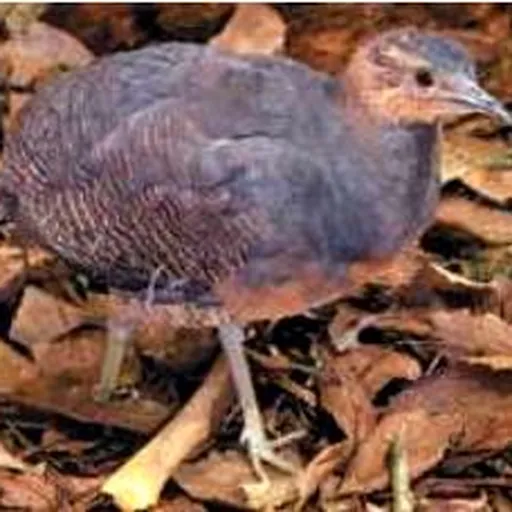
Yellow-legged Tinamou
Crypturellus noctivagus
Near Threatened
Overview
The yellow-legged tinamou (Crypturellus noctivagus) is a species of tinamou found in wooded and shrubby habitats across tropical and subtropical eastern Brazil. Currently listed as Near Threatened by the IUCN, the population is declining due to human activities such as habitat destruction and hunting pressure.
Identification
- Length of approximately 28 to 31 cm with grey-brown plumage that is superficially quail-like.
- Upperparts are grey with barred black lower back and wings, while the lower breast is rufous and the belly is whitish.
- Features a blackish cap and a buffy supercilium that is broadest and most prominent in the zabele subspecies.
- Possesses distinct yellow legs, which appear brighter in the zabele race than in the nominate race.
Habitat
This species prefers humid forest environments but also occupies drier wooded habitats such as savanna-woodland and Caatinga, particularly the zabele subspecies. It occurs at elevations of 700 m or less throughout eastern Brazil, ranging from southeastern states like Paraná and Rio Grande do Sul to northeastern areas including Paraíba and Piauí.
Diet
The yellow-legged tinamou forages on the ground or in low-lying bushes to consume fruit. It supplements this diet with small amounts of invertebrates, flower buds, tender leaves, seeds, and roots.
Did you know?
Males of this species are solely responsible for incubating eggs, which may come from as many as four different females. After hatching, the male continues to raise the chicks until they are independent, typically lasting 2 to 3 weeks.
Sources
- Wikipedia · CC BY-SA 4.0
- Wikidata · CC0 1.0