
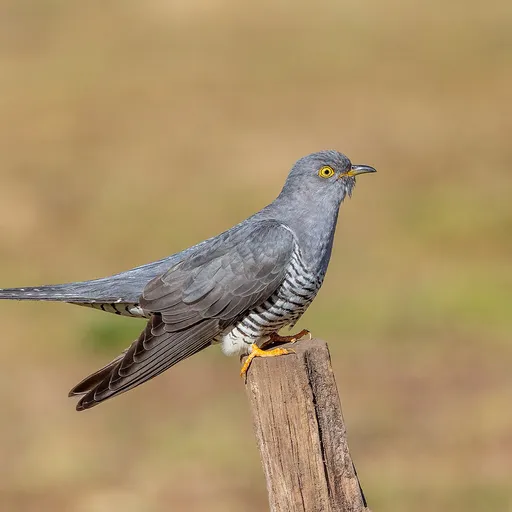
Common Cuckoo
Cuculus canorus
Least Concern
Listen
XC806565 · Isabel R. · Kitzingen (near Marktbreit), Lower Franconia, Bavaria, Germany · CC0 1.0
Overview
The common cuckoo, also known as the European or Eurasian cuckoo, is a widespread summer migrant to Europe and Asia that winters in Africa. It is an obligate brood parasite, meaning it lays its eggs in the nests of other bird species rather than raising its own young. The species is classified as least concern by the IUCN, with a global population estimated between 25 million and 100 million individuals.
Identification
- Size and build: 32–34 cm long with a long tail, 55–60 cm wingspan, and short legs; greyish, slender body.
- Plumage: Adult males are slate-grey with barred underparts; females may be grey or have a rufous morph with reddish-brown upperparts and dark bars.
- Head and legs: Yellow iris, orbital ring, bill base, and feet.
- Song: Male's distinctive 'goo-ko' call, delivered from an open perch, with a descending minor third interval that widens through the season.
Habitat
Essentially a bird of open land, the common cuckoo is found across a vast range from Ireland and Scandinavia through northern Russia and Siberia to Japan in the east, and from the Pyrenees through Turkey, Kazakhstan, Mongolia, northern China and Korea. It arrives in Europe in April and leaves in September, spending the winter in Africa and South Asia.
Diet
The common cuckoo feeds on insects, with a particular preference for hairy caterpillars that are distasteful to many other birds. It also occasionally consumes eggs and chicks.
Did you know?
The female common cuckoo can retain an egg inside its body for an extra 24 hours before laying it in a host nest, allowing the cuckoo chick to hatch before the host's own eggs and then eject them from the nest.
Sources
- Wikipedia · CC BY-SA 4.0
- Wikidata · CC0 1.0