
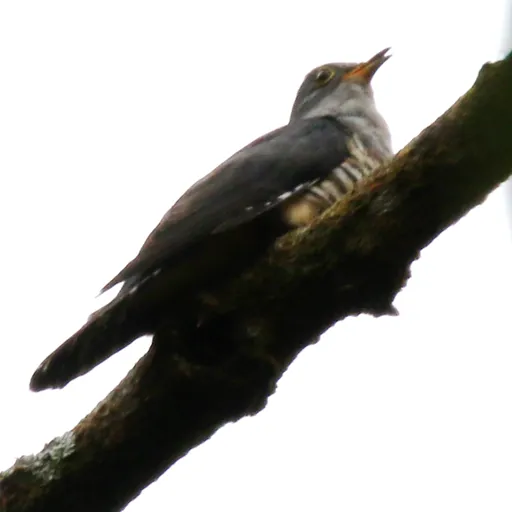
Sunda Cuckoo
Cuculus lepidus
Least Concern
Overview
The Sunda cuckoo (Cuculus lepidus) is a non-migratory South-east Asian bird belonging to the cuckoo family. It was formerly considered part of the Himalayan cuckoo complex but is now often treated as a separate species based on distinct differences in voice, size and plumage.
Identification
- Length of 29–30 cm with dark grey upperparts, throat and upper breast.
- Buff underparts marked with black bars, and a blackish tail with white spots.
- Females may appear in a rufous form with reddish-brown upperparts, paler underparts, and black barring above and below.
- Song consists of a short first note followed by two or three longer, lower-pitched 'hoop' notes.
Habitat
Found across the Malay Peninsula, Borneo, Sumatra, Java, Bali, Seram and the Lesser Sunda Islands east to Timor. It inhabits forests, predominantly in mountainous areas, at altitudes ranging from 950 m in the Malay Peninsula to as high as 2700 m in Borneo.
Diet
The species feeds mainly on insects, particularly caterpillars, and will also consume fruit. It is described as a secretive bird that is difficult to observe directly, often detected only when calling.
Did you know?
As a brood parasite, it lays whitish eggs with brown spots in the nests of other species, including the chestnut-crowned warbler, mountain leaf warbler and Sunda bush warbler.
Sources
- Wikipedia · CC BY-SA 4.0
- Wikidata · CC0 1.0