
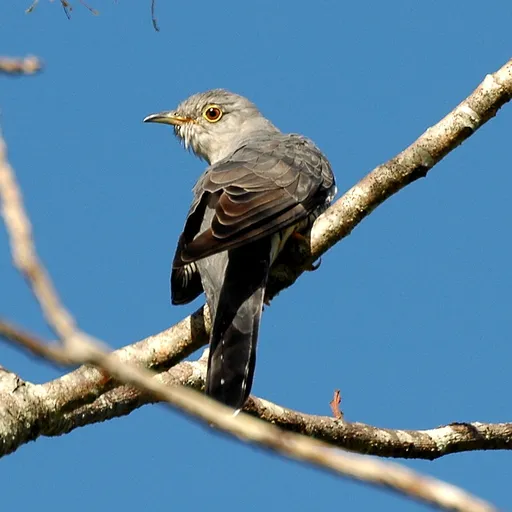
Oriental Cuckoo
Cuculus optatus
Least Concern
Overview
The Oriental cuckoo, also known as Horsfield's cuckoo (Cuculus optatus), is a bird in the genus Cuculus within the cuckoo family. Formerly classified as a subspecies of the Himalayan cuckoo, it is now recognised as a separate species due to differences in voice and size.
Identification
- Adult males possess a grey head, breast, and upperparts with a creamy-white belly marked by dark bars, complemented by orange-yellow legs and feet and a bare yellow ring around the eye.
- Females and juveniles exhibit two morphs: a grey variant similar to the male but with a brownish breast wash, and a rufous variant that is reddish-brown above with strong dark bands covering the underparts and rump.
- The male call consists of a series of low paired notes described as 'poo-poo', with both notes stressed equally, sometimes accompanied by introductory phrases or grating notes.
- The female produces a deep bubbling trill, while the species remains mostly silent outside the breeding season.
Habitat
This species has a large breeding range across northern Eurasia, including parts of Russia, Kazakhstan, Mongolia, China, Korea, and Japan. It primarily inhabits coniferous, deciduous, and mixed forests, though its exact wintering range remains uncertain and likely extends to the Malay Peninsula, Indonesia, the Philippines, New Guinea, and parts of Australia.
Diet
The Oriental cuckoo feeds mainly on insects and their larvae, foraging in trees and bushes as well as on the ground. It is a brood parasite that lays eggs in the nests of other birds, such as Phylloscopus warblers and the olive-backed pipit, with chicks that subsequently push host eggs or nestlings out of the nest.
Did you know?
The species is noted for its secretive habits, which contribute to the difficulty in determining its exact wintering range. Additionally, the rufous morph is suggested to have evolved to deter male harassment or mobbing by host species.
Sources
- Wikipedia · CC BY-SA 4.0
- Wikidata · CC0 1.0