
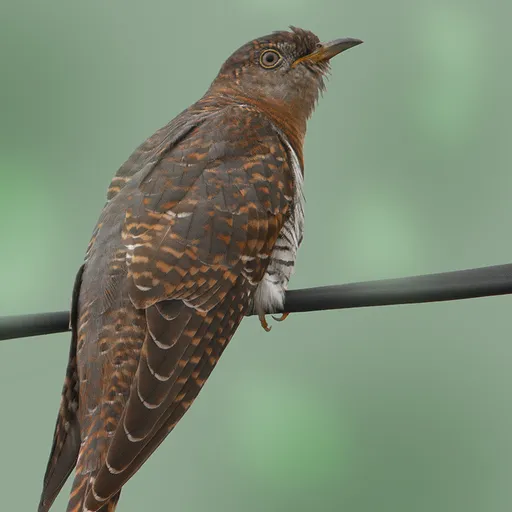
Himalayan Cuckoo
Cuculus saturatus
Least Concern
Overview
The Himalayan cuckoo, or Cuculus saturatus, is a brooding parasitic bird belonging to the family Cuculidae. It is classified as Least Concern on the IUCN Red List, indicating it is not currently globally threatened.
Identification
- Size and Weight: Approximately 30–35 cm in length and weighs between 70–140 g.
- Plumage: Adult males are dark ashy-grey above with a black tail that is whitely spotted and tipped; the underside is white with black bars. Females and some males exhibit a rufous morph with dark bars.
- Bill and Legs: Bills are black with an orange-yellow or green-yellow base; legs and feet range from yellow to orange.
- Song: Males produce a call described as "hoop, hoop-hoop" or "tun-tadun", similar to a Common Hoopoe but lower-pitched and muffled, alongside hoarse croaks. Females emit a bubbling "quick-quick-quick" sound.
Habitat
During breeding season, the species inhabits mixed coniferous and deciduous forests, thickets, and mountain forests in the Himalayas, eastern China, and Taiwan, typically found above 1000 m and occasionally reaching up to 4500 m. In winter, it migrates to southeast Asia, the Greater Sunda Islands, and parts of Australia, residing in primary and secondary tropical forests, savannas, gardens, and plantations.
Diet
The diet consists primarily of insects, especially caterpillars such as those from the families Arctiidae and Sphingidae, which the bird prepares by removing the gut contents before consumption. It also feeds on grasshoppers, beetles, spiders, and occasionally fruits, pine shoots, or eggs taken from other birds' nests. Foraging is generally arboreal but can include the ground and short aerial sallies, with large groups forming when food sources like teak moths are abundant.
Did you know?
A single female can lay her eggs in as many as fifteen different host nests, placing one egg in each location to maximize reproductive success. During a teak moth infestation in New Guinea, an extreme gathering of at least 300 individuals was observed feasting on the available food source.
Sources
- Wikipedia · CC BY-SA 4.0
- Wikidata · CC0 1.0