
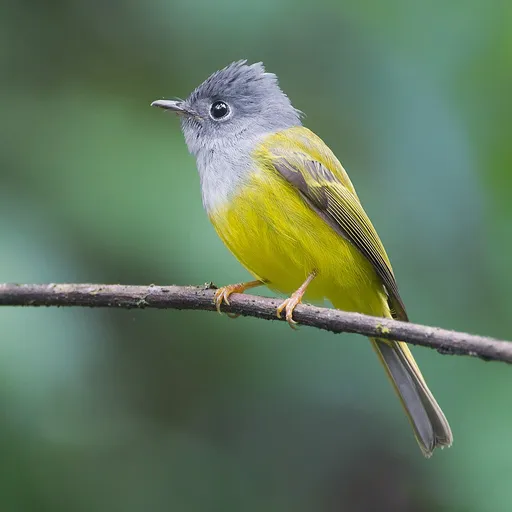
Grey-headed Canary-flycatcher
Culicicapa ceylonensis
Least Concern
Listen
XC1067758 · Ujjal Kishor De · KUMARGHAT NAGAR VAN CITY PARK MAIN GATE (near Kumarghat), Tripura, India · CC BY-SA 4.0
Overview
The grey-headed canary-flycatcher (Culicicapa ceylonensis), also known as the grey-headed flycatcher, is a small bird native to tropical Asia that belongs to the family Stenostiridae rather than the traditional Old World flycatchers. It is a resident or partial migrant in forested habitats ranging from temperate to tropical southern Asia.
Identification
- Length of 12–13 cm with a distinct squarish grey head and canary yellow belly.
- Upperparts are yellowish-green, while the sexes are indistinguishable in plumage.
- Possesses a very flat, triangular bill fringed with long rictal bristles.
- Perches in a very upright posture and exhibits flycatcher-like sallies.
Habitat
Breeds in upland to montane oak and broadleaf forests across temperate to tropical southern Asia, extending from Pakistan to Indonesia and southern China. During the non-breeding season, populations often move to lower elevations, favouring mature secondary forests, abandoned plantations, and overgrown gardens near water. Some Himalayan populations are partial migrants that winter in peninsular India, while others remain resident at altitudes above 2,000 m ASL.
Diet
An insectivore that forages actively like a flycatcher, making sallies for aerial insects from low perches under the canopy. It is highly active and noisy, foraging at all levels of the forest and frequently joining mixed-species flocks.
Did you know?
The female constructs the nest entirely alone, creating an unlined cup bound by cobwebs that is often attached to and covered by moss on tree trunks, rocks, or mud banks.
Sources
- Wikipedia · CC BY-SA 4.0
- Wikidata · CC0 1.0