
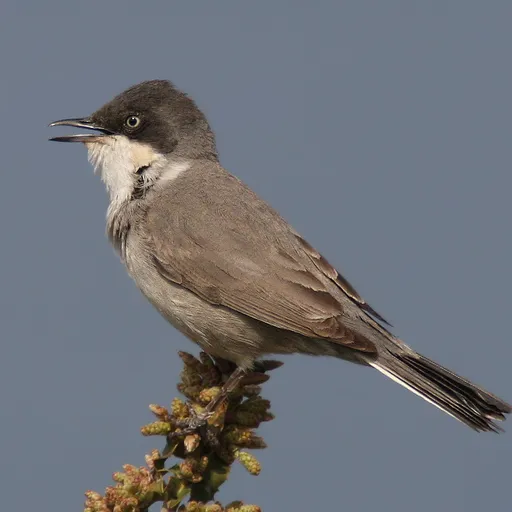
Eastern Orphean Warbler
Curruca crassirostris
Least Concern
Overview
The eastern Orphean warbler (Curruca crassirostris) is an Old World warbler of the genus Curruca and is classified as Least Concern on the IUCN Red List. It is one of the largest species of typical warblers, measuring 15–16 cm in length.
Identification
- Adult males possess a plain grey back, a dark grey head with a black eye mask, and a white throat.
- The bill is long and pointed, the legs are black, and the male iris is white, whereas females and immatures have dark irises, a paler head, and reddish underparts with a brownish-tinged grey back.
- The song consists of a series of warbling liroo-liroo notes and scolding calls, exhibiting greater variety and richness than that of the western Orphean warbler.
- Visually, the species is difficult to distinguish from the western Orphean warbler.
Habitat
This species breeds in summer across the Mediterranean region, extending through the Balkans, Turkey, the Caucasus, and into Central Asia. It is a migratory bird that winters in sub-Saharan Africa and typically inhabits open deciduous woodland.
Diet
Like most 'warblers', the eastern Orphean warbler is a nectarivore. The text does not specify further details regarding foraging behaviour or other dietary components.
Sources
- Wikipedia · CC BY-SA 4.0
- Wikidata · CC0 1.0