
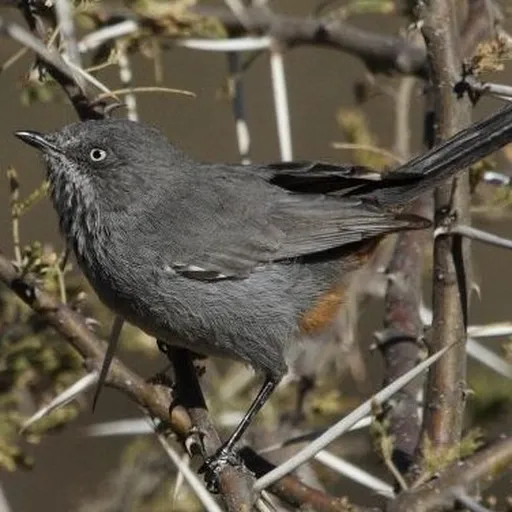
Chestnut-vented Warbler
Curruca subcoerulea
Least Concern
Overview
The chestnut-vented warbler, also known as the chestnut-vented tit-babbler or rufous-vented warbler, is an Old World warbler belonging to the family Sylviidae. It is classified as a species of Least Concern on the IUCN Red List.
Identification
- Length of 14–15 cm with a weight of approximately 16 g.
- Grey-brown upperparts with a black tail featuring a broad white band at the tip.
- Bright chestnut vent contrasting with grey breast and belly, and a grey throat with heavy dark streaking.
- White eye ring, black legs, and grey eyes; the call is described as a loud fluted cheerup-chee-chee.
Habitat
This species breeds across southern Africa, including Angola, Botswana, Zimbabwe, Zambia, Namibia, South Africa, Lesotho, Mozambique, and Eswatini. It is a common inhabitant of diverse environments such as fynbos, scrub, thickets, and dry riverbeds.
Diet
The bird forages for insects and other small invertebrates while moving through vegetation. It is typically observed alone or in pairs during foraging activities.
Did you know?
The specific epithet in its scientific name, Curruca subcoerulea, derives from Latin roots meaning 'somewhat blue' or 'pale blue', a reference that does not immediately align with its prominent chestnut vent.
Sources
- Wikipedia · CC BY-SA 4.0
- Wikidata · CC0 1.0