
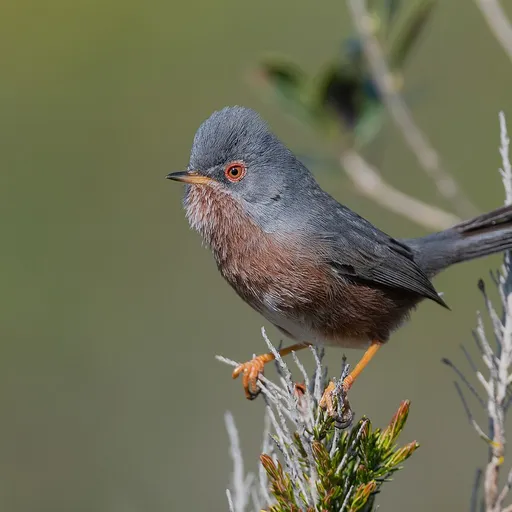
Dartford Warbler
Curruca undata
Near Threatened
Listen
XC776787 · Sonothèque ADVL · Carolles, Manche, Normandie, France · CC0 1.0
Overview
The Dartford warbler (Curruca undata) is a small Sylviid warbler found in the warmer parts of western Europe and northwestern Africa. Classified as Near Threatened by the IUCN, it is naturally rare but has seen population fluctuations due to climate changes and habitat availability.
Identification
- Small, 13 cm passerine with unobtrusive, muted plumage that blends with dry vegetation, featuring a notably long tail and thin, pointed bill.
- Males display grey-brown upperparts and dull reddish-brown underparts, with a dirty white patch on the belly centre, light speckles on the throat, and a distinct red eye-ring.
- Females resemble males but are browner above and paler below, with less marked throat speckles; juveniles are similar to females.
- Possesses a distinctive song described as a rattling warble.
Habitat
The breeding range extends west of a line from southern England to the heel of Italy, with the largest populations in the Iberian Peninsula. It inhabits open fields with degraded scrub brush, heather, and heathlands, often nesting in dense bushes like gorse or heather within 60 cm of the ground. While usually resident, some limited migration occurs, and it may visit urban areas in winter if shrubs are present.
Diet
Mostly insectivorous, the species feeds on caterpillars, butterflies, beetles, and spiders. It forages within shrubs, even in urban areas during winter, and both parents feed arthropods to chicks after they fledge.
Did you know?
The specific epithet 'undata' derives from Medieval Latin meaning 'with wavy markings', yet the bird is visually characterised more by its muted, unobtrusive tones than by visible waviness. It nearly went extinct in the United Kingdom during the severe winter of 1962/1963, when the national population dropped to just ten pairs.
Sources
- Wikipedia · CC BY-SA 4.0
- Wikidata · CC0 1.0