
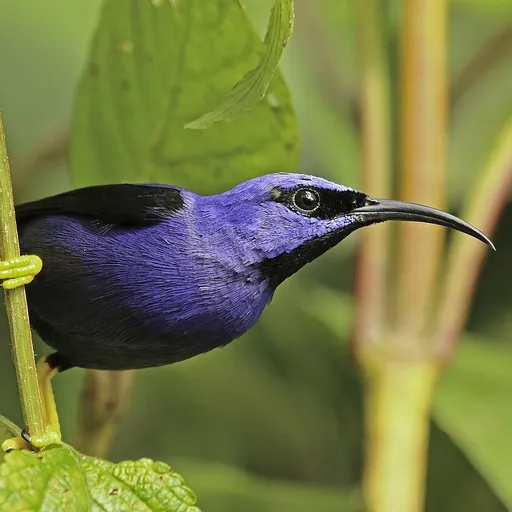
Purple Honeycreeper
Cyanerpes caeruleus
Least Concern
Overview
The purple honeycreeper, Cyanerpes caeruleus, is a small Neotropical bird belonging to the family Thraupidae. It is the most common and widespread member of its genus, with an estimated stable population of at least five million mature individuals.
Identification
- Adult males of the nominate subspecies are mostly violet-blue with a slightly lighter face, black lores, and a narrow black mask extending past the eye; females feature a green crown, buffy lores, a bright blue malar stripe, and a cinnamon-buff supercilium.
- The species measures 9.3 to 11.4 cm in length and weighs between 7.8 and 14 g, with a slender, decurved black bill and brown to black irises.
- Males possess yellow legs and feet, while females have light green to olive-yellow legs; the species lacks a distinct song, instead producing calls described as a 'zhree' or a short, high, lisping 'psit'.
Habitat
Found in Panama, Trinidad, and mainland South America excluding Argentina, Chile, Paraguay, and Uruguay, the purple honeycreeper inhabits various types of evergreen forest in lowlands and foothills. It utilises both terra firme and várzea forests in the Amazon Basin, as well as clearings, secondary forest, and ecotones with savanna or cerrado, reaching elevations of up to 2,300 m in Colombia.
Diet
This species feeds primarily on arthropods such as insects and spiders, supplemented by significant amounts of fruit and nectar from a wide variety of plants. Its bill shape enables it to extract nectar from bromeliads and fleshy arils, making it an important pollinator and seed disperser. Foraging occurs actively in the subcanopy and canopy, typically in pairs, family groups, or mixed-species flocks.
Did you know?
The specific epithet 'caeruleus' is Latin for 'dark blue', a reference that contrasts with the violet-blue plumage of adult males. At the Asa Wright Nature Center on Trinidad, the species readily feeds on nectar from hummingbird feeders and consumes banana and papaya on tray feeders.
Sources
- Wikipedia · CC BY-SA 4.0
- Wikidata · CC0 1.0