
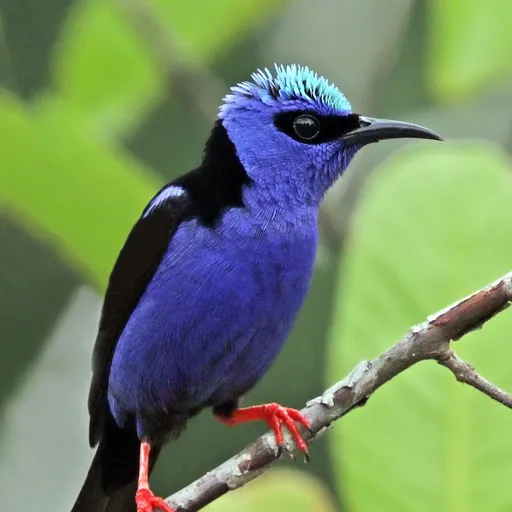
Red-legged Honeycreeper
Cyanerpes cyaneus
Least Concern
Overview
The red-legged honeycreeper (Cyanerpes cyaneus) is a small songbird in the family Thraupidae, found across Mexico, Central America, Trinidad and Tobago, and most of mainland South America. Assessed as Least Concern by the IUCN, it is a wide-ranging species with a stable population estimated at at least five million mature individuals.
Identification
- Length of 11 to 13 cm with a slender, decurved bill and blackish bill; males have bright red legs and females have dull reddish legs.
- Sexually dimorphic; breeding males are mostly bright purplish blue with a shaggy azure-blue crown, black mask, nape patch, and tail, contrasting with bright yellow underwing coverts.
- Females possess dull olive-green upperparts and light yellow underparts with faint greenish streaks.
- Calls are constant and varied, described as buzzy or lisping sounds such as a "thin, whiny chee'eeez" or a "lisping, rising, trilled dzrrreet".
Habitat
The species inhabits a wide variety of somewhat open landscapes, including forest edges, mature secondary forest, clearings, shaded coffee and cacao plantations, gallery forest, savanna woodlands, and parks with trees. It occurs across a broad elevation range, reaching up to 1,750 m in northern Central America and 2,000 m in Brazil, though it is less frequent in extensive primary forest.
Diet
This honeycreeper feeds primarily on fruits and arthropods, consuming lesser amounts of nectar. It forages in the forest's middle to upper levels, often in mixed-species flocks, by hyperactively hopping and flicking its wings. It gleans insects from leaves and branches, sometimes hanging upside down, and frequently takes prey in mid-air with sallies from a perch, also visiting feeders and restaurant tables.
Did you know?
The species regularly visits feeders and is known to take food from restaurant tables. Its breeding season varies geographically, including May in Mexico, February to June in Costa Rica, and at least September to December in Brazil.
Sources
- Wikipedia · CC BY-SA 4.0
- Wikidata · CC0 1.0