
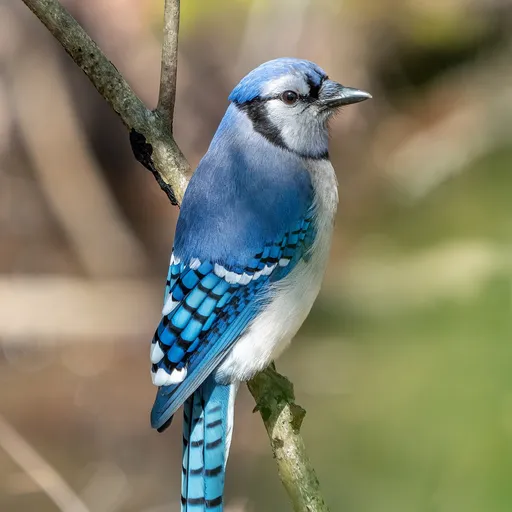
Blue Jay
Cyanocitta cristata
Least Concern
Listen
XC757631 · Quinn Desilets · Seba Beach, Parkland County, Alberta, Canada · CC0 1.0
Overview
The blue jay, Cyanocitta cristata, is a passerine bird in the family Corvidae native to eastern North America. It is a noisy, bold, and aggressive species that has adapted well to human activity, often occurring in parks and residential areas.
Identification
- Predominantly lavender-blue to mid-blue plumage on the crest, back, wings, and tail, with a white face and off-white underparts.
- A prominent blue crest that is raised when the bird is excited or aggressive, and flattened when resting.
- A black, U-shaped collar around the neck and a black border behind the crest.
- Black, strong bill used for cracking nuts, along with black legs and eyes.
Habitat
The blue jay occurs from southern Canada throughout the eastern and central United States, south to Florida and northeastern Texas. It inhabits a variety of environments, from pine woods to spruce-fir forests, but prefers mixed woodlands with oaks and beeches over denser forests. The species is also common in residential areas and parks.
Diet
Blue jays are omnivorous, with an estimated 75% of their diet consisting of vegetable matter such as acorns, beech mast, weed seeds, and fruit. They also consume arthropods, small invertebrates, and occasionally eggs or nestlings of other birds. They forage by gleaning from trees, shrubs, and the ground, and sometimes hawk insects from the air.
Did you know?
Blue jays can copy the cries of local hawks so well that it is sometimes difficult to distinguish between the two sounds. Additionally, the blue coloration of their feathers is not derived from pigments but is the result of light interference due to the internal structure of the feathers, meaning the color disappears if the feather is crushed.
Sources
- Wikipedia · CC BY-SA 4.0
- Wikidata · CC0 1.0