
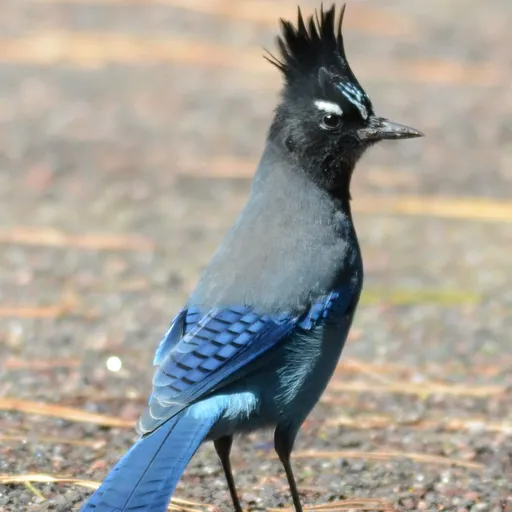
Steller's Jay
Cyanocitta stelleri
Least Concern
Listen
XC644895 · Diana Doyle · Big Bear, San Bernardino County, California, United States · CC BY-SA 4.0
Overview
Steller's jay (Cyanocitta stelleri) is a bird native to western North America and the mountains of Central America, closely related to the blue jay (C. cristata) found in eastern North America. It is the only crested jay west of the Rocky Mountains and is sometimes colloquially referred to as a "blue jay" in the Pacific Northwest, although it is distinct from the eastern species.
Identification
- Length of 30–34 cm (12–13 in) with a weight of 100–140 g (3.5–4.9 oz), featuring a more slender bill and longer legs than the blue jay.
- Head is blackish-brown, black, or dark blue depending on the subspecies, with lighter streaks on the forehead that transition to silvery blue on the shoulders and lower breast.
- Primaries and tail are rich blue with darker barring; head markings vary regionally from white spots in the east to light blue or no markings on the far Pacific Coast.
- Vocalisations include a harsh "SHACK-Sheck" series, a pump-handle-like "skreeka", and a soft "hoodle" whistle, as well as the ability to mimic other birds, animals, and non-animal sounds.
Habitat
Steller's jay occurs in most forested areas of western North America from southern Alaska to northern Nicaragua, as well as in Mexico's interior highlands and parts of Central America. It primarily inhabits coniferous and pine-oak forests from low to moderate elevations, occasionally reaching the tree line, and is also common in residential and agricultural areas with nearby forests.
Diet
As an omnivore, its diet consists of approximately two-thirds plant matter and one-third animal matter, including seeds, nuts, berries, invertebrates, small rodents, and eggs. Acorns and conifer seeds are staples during the non-breeding season, often cached for later consumption, and the birds frequently scavenge from human food sources such as picnics and campsites.
Did you know?
Steller's jays are skilled mimics that can imitate the calls of birds of prey, such as red-tailed hawks, to warn others of danger or assert territorial behaviour, which causes other birds to seek cover and flee feeding areas.
Sources
- Wikipedia · CC BY-SA 4.0
- Wikidata · CC0 1.0