
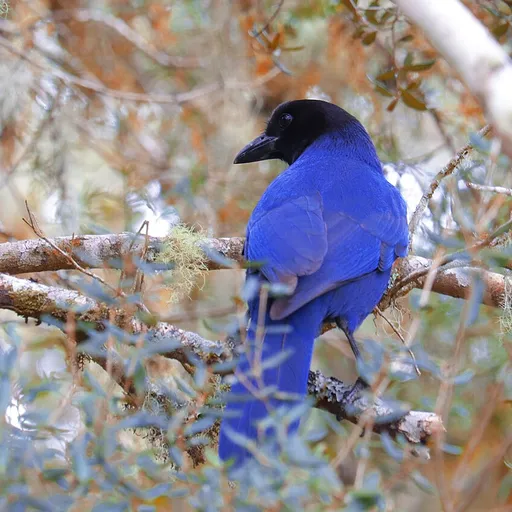
Azure Jay
Cyanocorax caeruleus
Listen
XC433994 · maria belotti · Cananéia, São Paulo, Brazil · CC BY-SA 4.0
Overview
The azure jay (Cyanocorax caeruleus) is a Near Threatened passerine bird belonging to the crow and jay family, Corvidae. It is a year-round resident found across parts of southern South America, particularly in humid evergreen forests. The species is noted for its omnivorous diet and role in seed dispersal, though its population is believed to be declining due to habitat loss.
Identification
- Body length of 38 to 40 cm with a short, bushy crest on the forecrown.
- Adults possess a sooty or black head, neck, and upper breast, contrasting with cobalt-blue, purplish blue, or greenish blue plumage on the remainder of the body.
- Features a black bill, black legs and feet, and a dark brown iris.
- Vocalisations include a shrill, repetitive call transcribed as 'Kiaahh- kiaahh- kiaahh'.
Habitat
Found in Brazil from southern São Paulo south through Paraná, Santa Catarina, and Rio Grande do Sul, extending into the northeastern Argentinian provinces of Formosa, Chaco, Corrientes, and Misiones. Its range likely includes eastern Paraguay and Uruguay, though records for Paraguay are disputed and some authorities do not include it. The species inhabits humid evergreen forests, especially those dominated by Araucaria angustifolia, at elevations ranging from sea level to 1,000 m.
Diet
The azure jay is omnivorous, feeding heavily on Araucaria angustifolia seeds, which it helps disperse, as well as other fruits, arthropods, small mammals, and eggs. It has also been observed scavenging from carcasses. Foraging typically occurs in small flocks that may occasionally include plush-crested jays.
Did you know?
The azure jay is a cooperative breeder that constructs flat cup nests from twigs lined with softer roots, producing clutches of four greenish-blue eggs speckled with grey and brown spots.