
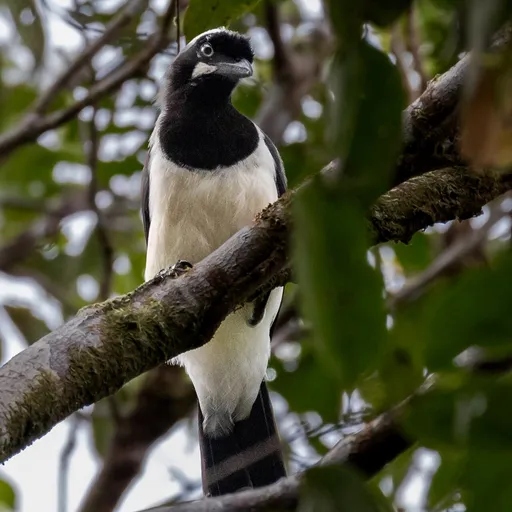
Cayenne Jay
Cyanocorax cayanus
Least Concern
Overview
The Cayenne jay is a medium-sized bird species belonging to the family Corvidae. Originally described by French zoologist Mathurin Jacques Brisson in 1760 based on a specimen from French Guiana, it was later formalised by Carl Linnaeus in 1766.
Identification
- Approximately 33 cm in length with a purplish-brown back and tail featuring a white tip.
- Wings display a gradient from purplish-brown to darker purplish-blue, while the neck is sooty grey fading to white undersides.
- Black face and throat marked by white spots above and below the eye and along the malar, edged in mauve.
- Short black crest on the head, accompanied by a black beak and tarsus with light blue or white irises.
Habitat
Found across Brazil, French Guiana, Guyana, Suriname, and Venezuela, this species inhabits subtropical or tropical moist lowland forests. It also occupies subtropical or tropical dry shrubland and heavily degraded former forests.
Did you know?
The species was first described in 1760 by the French zoologist Mathurin Jacques Brisson using the name Le geay de Cayenne. Although Brisson coined Latin names, they did not conform to the binomial system and were not recognised by the International Commission on Zoological Nomenclature.
Sources
- Wikipedia · CC BY-SA 4.0
- Wikidata · CC0 1.0