
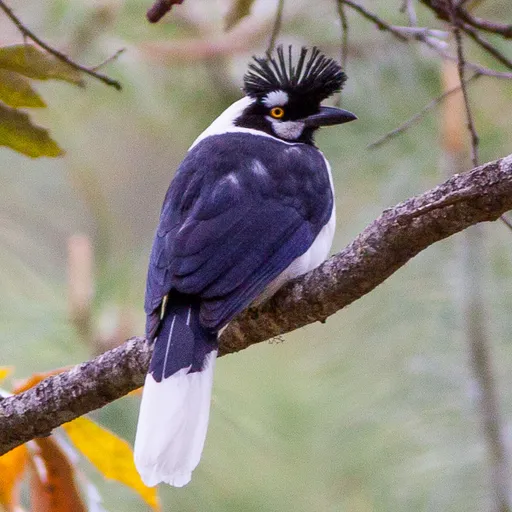
Tufted Jay
Cyanocorax dickeyi
Near Threatened
Overview
The tufted jay, also known as the painted jay or Dickey's jay (Cyanocorax dickeyi), is a distinctive bird in the crow family Corvidae that is endemic to a small area of the Sierra Madre Occidental in Mexico. It is currently classified as near threatened by the IUCN due to habitat destruction and a decreasing population of 10,000–20,000 mature individuals.
Identification
- A large jay with a prominent black crest on the head that fades to dark blue at the base, and a purplish blue back, wings, and face. Features white spots above the eyes and on the cheeks, a white nape and belly, and a partially white tail. The bill and legs are black, with bright yellow irises in adults, while immature birds have brown irises and lack the white eye spots. Flight is described as buoyant with constant wing flapping, and the typical call is a rapid, four-note vocalization transcribed as 'rak', 'chuck', 'chen', or 'ca'.
Habitat
Found exclusively in pine-oak forests and ravines near water sources within the Sierra Madre Occidental of eastern Sinaloa, western Durango, and northern Nayarit, Mexico. Most commonly occurs at elevations of 1,500–2,000 m, though individuals have been recorded between 1,200 m and 2,500 m. They remain almost always near treetops and within the forest canopy, rarely descending to the ground.
Diet
The diet is composed primarily of plant matter, including blackberries, nuts, acorns, and Peltostigma fruit, which makes up roughly 70% of their intake. The remaining 30% consists of arthropods such as katydids, beetles, and wasps, and they have also been observed eating eggs stolen from other birds' nests. They forage in flocks, often perching on branches to pry, pull, or hammer at food sources, or hanging from higher branches to reach down.
Did you know?
Despite a geographic gap of over 2,000 km, the tufted jay is genetically most closely related to a group of South American jays rather than its nearby Mexican counterparts. This suggests the species descended from an ancestral jay that once ranged throughout Central and South America.
Sources
- Wikipedia · CC BY-SA 4.0
- Wikidata · CC0 1.0