
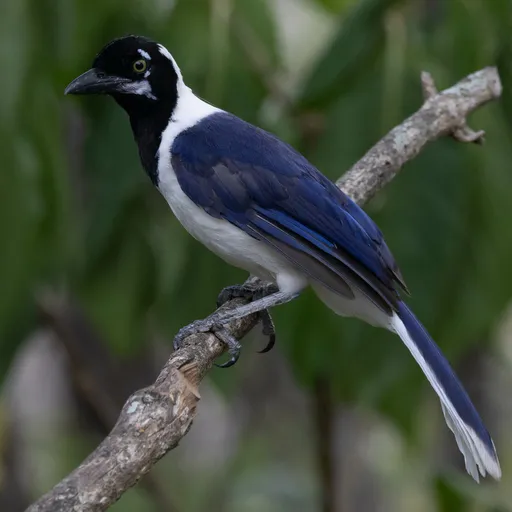
White-tailed Jay
Cyanocorax mystacalis
Least Concern
Listen
XC242469 · Niels Krabbe · Loja: Tambo Negro 10 km E Macará, Ecuador · CC BY-SA 4.0
Overview
The white-tailed jay, also known as the moustached jay, is a non-migratory bird in the crow family found in northwestern Peru and southwestern Ecuador. It is listed as Least Concern by the IUCN, although its population is believed to be decreasing due to habitat destruction.
Identification
- Roughly 33 cm in length with a black head, white nape, belly, and underparts, and greyish-blue back and wings.
- Distinctive white markings include a small spot above the eye, a moustachial stripe, and a spot on the cheek, alongside white rectrices and tail tips.
- Adults possess bright yellow irises, whereas juveniles have brown irises and lack the white head markings.
- Most common call is described as "cha-cha-cha-cha", varying in pitch, with a less frequent high-pitched "clewp-clewp" call.
Habitat
Inhabits semi-humid, semi-open woodlands such as mesquite woodlands and cactus steppe, from sea level up to 1,200 m. It prefers areas with thick vegetation close to rivers and streams, and in parts of Ecuador, it can be seen in cloud forests at higher elevations.
Diet
Feeds primarily on insects, such as beetles and ants, and seeds, but also steals eggs from other birds, including the endangered Peruvian plantcutter and domestic poultry. It forages in flocks of up to ten individuals or alone, often on the ground in semi-open areas and gardens.
Did you know?
Despite being visually very similar to the tufted jay found in Mexico, a 2010 mitochondrial DNA study proved they are not particularly closely related, contradicting earlier theories that suggested a close common ancestor.
Sources
- Wikipedia · CC BY-SA 4.0
- Wikidata · CC0 1.0