
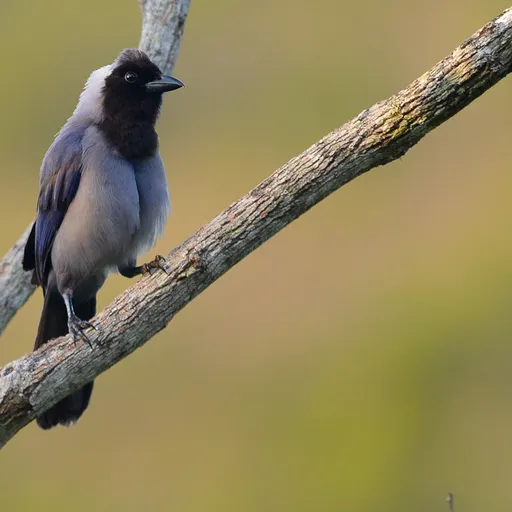
Violaceous Jay
Cyanocorax violaceus
Least Concern
Listen
XC944591 · Gonzalo Nazati · San Pablo de Ushpayacu (near Lushanta), Cantón Archidona, Napo, Ecuador · CC BY-SA 4.0
Overview
The violaceous jay, Cyanocorax violaceus, is a species of bird in the family Corvidae found across South America. It is classified as Least Concern by the IUCN, though its population size is believed to be decreasing.
Identification
- Length 33 to 37 cm with a mass of about 260 g, featuring blackish forecrown and throat in nominate males, while underparts and upper back display violaceous blue.
- Subspecies C. v. pallidus exhibits the same pattern but is significantly paler overall, and both subspecies possess a dark brown iris, black bill, and black legs.
- Typical vocalisation includes a downwardly inflected 'Jeeeer!' given several times, accompanied by clop-clop-clop-clop sounds, quiet chortling gurgles, a descending ripple, and guttural clicking.
Habitat
Primarily inhabits a variety of forested landscapes, including primary and secondary forests, with a preference for areas near watercourses. In specific regions such as Brazil, Ecuador, and Peru, it favours várzea forest, while in other areas it occupies elevations ranging from lowlands up to 1,400 m.
Diet
An omnivore that primarily feeds on fruit, arthropods, and eggs, with observations also recording it eating lizards. It forages in flocks of up to 12 individuals, keeping mostly within the forest canopy.
Did you know?
Although little is known about its breeding habits, a single nest discovered in Venezuela contained five bluish-white eggs with brown speckles, constructed from large twigs and fine plant fibres and placed approximately 9 m above the ground.
Sources
- Wikipedia · CC BY-SA 4.0
- Wikidata · CC0 1.0