
Inca Jay
Cyanocorax yncas
Least Concern
Listen
XC250744 · Niels Krabbe · Zamora-Chinchipe: Reserva Tapichalaca, near Q. Cristopher Parson, Ecuador · CC BY-SA 4.0
Overview
The Inca jay (Cyanocorax yncas) is a New World jay species native to the Andes of South America. It belongs to the genus Cyanocorax and is widely known in Spanish as querrequerre, an onomatopoeic name derived from its call.
Identification
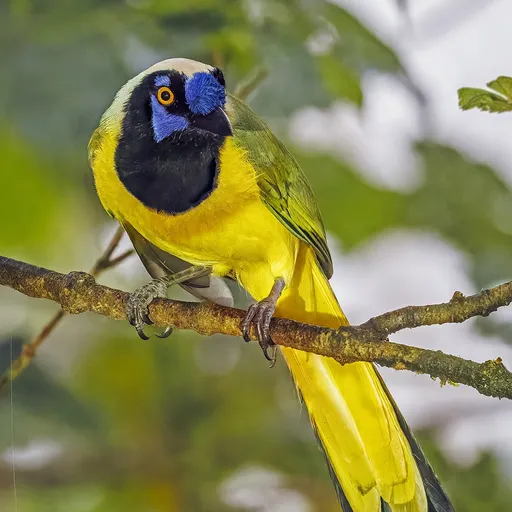
- Measures 29.5–30.5 cm (11.6–12.0 in) in length with rich green upper parts and bright yellow breast and underparts.
- Features a black bib that forms a broad band to the sides of the head, along with stripes through and above the eye line.
- The crown appears mostly white, with blue limited to the frontal crest and nape, and the iris is bright yellow.
- Most common call is a 'rassh-rassh-rassh' sound, though the species has an extensive voice repertoire including a distinctive alarm bell call.
Habitat
The Inca jay's range extends southwards in the Andes from Colombia and Venezuela through Ecuador, Peru, and into central Bolivia. Its conservation status is currently listed as Least Concern.
Diet
The basic diet consists of arthropods, vertebrates, seeds, and fruit.
Did you know?
The bird's common Spanish name, querrequerre, is an onomatopoeia that mimics its call. In Venezuela, Inca jays have been observed as victims of nest parasitism by giant cowbirds.
Sources
- Wikipedia · CC BY-SA 4.0
- Wikidata · CC0 1.0