
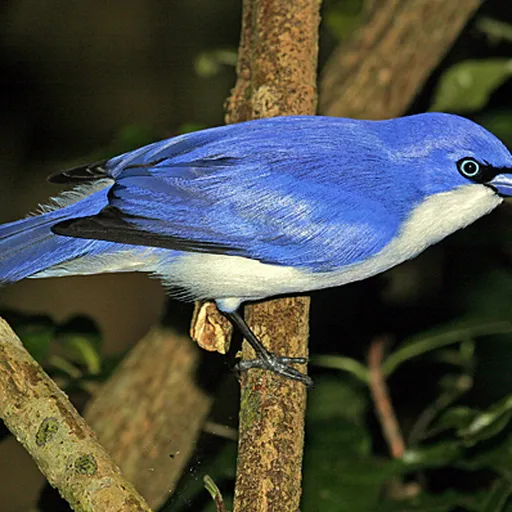
Madagascar Blue Vanga
Cyanolanius madagascarinus
Near Threatened
Overview
The Madagascar blue vanga (Cyanolanius madagascarinus) is a bird species in the family Vangidae found exclusively in Madagascar. Its natural habitats include subtropical or tropical dry and moist lowland forests, and it is currently classified as Near Threatened on the IUCN Red List.
Identification
- Length ranges from 16–19 cm, with adult males displaying bright blue plumage and bright white underparts, whereas females are duller with off-white underparts tinged pale orange or buff.
- A distinct black line runs through the eye to the base of the bill, and the tail and wing edges are black in males; the bill is pale or cold blue with a dark tip in males, and dark brown in females.
- Vocalisations include a very characteristic 'tcccch' call that may be repeated as 'chrr-crrk-crrk-crrrrk-crk-crk', along with 'teea teea teea' or harsh 'scheet' alarm calls.
Habitat
Found in northern, eastern, and western Madagascar, the species inhabits the midstory and canopy of deciduous dry forests, evergreen humid forests, littoral forests, adjacent second growth, and mangroves. It occurs up to an elevation of 1,200 m, though it has been reported as high as 1,600 m.
Diet
The diet consists mainly of insects such as beetles, crickets, cicadas, and caterpillars, along with spiders and occasional berries. Foraging takes place in the middle and upper levels of trees, often while hanging upside down, gleaning from the substrate, and sally-gleaning from branches and leaves.
- Typically forages in groups of up to six birds during the non-breeding season and in pairs while nesting, though it also joins mixed-species flocks.
Did you know?
Feeding behaviour is distinctive as the bird often hangs upside down from its feet to glean food. It has also been observed foraging in mangroves, an unusual habitat for a forest-dwelling vanga.
Sources
- Wikipedia · CC BY-SA 4.0
- Wikidata · CC0 1.0