
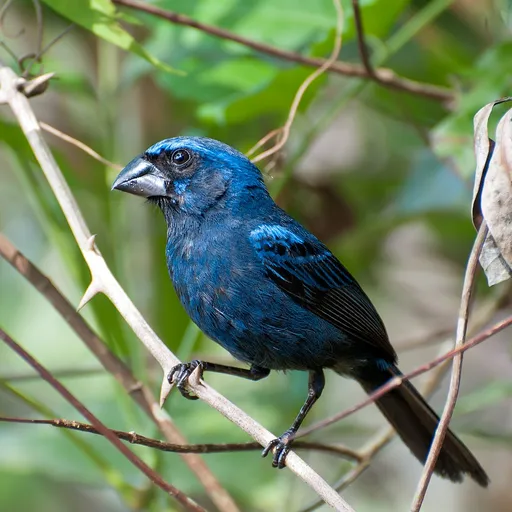
Ultramarine Grosbeak
Cyanoloxia brissonii
Least Concern
Listen
XC757206 · Rosa Elena Albornoz · Cecilio Acosta (near Caracas), Guaicaipuro, Miranda, Venezuela · CC0 1.0
Overview
The Cyanoloxia brissonii is a species of grosbeak in the family Cardinalidae found across eastern and central South America, with a disjunct population in the north. It is classified as Least Concern on the IUCN Red List and is generally a sedentary bird with only short-distance local migrations.
Identification
- Adult males display dark-blue plumage with bright-blue highlights on the head and upper wings, contrasting with black on the face, wings, and tail.
- Females and juveniles are brown, distinguishing them from the vibrant males.
- Both sexes are approximately 15 cm long, possess a large, thick bill, and have black legs.
Habitat
This species inhabits open or semi-open edge habitats, such as dense scrub, thickets, and the edges of swamps, secondary forests, and agricultural fields. Its range spans from northeast and central Brazil through Bolivia, Paraguay, and Argentina, including the Gran Chaco, with isolated populations in southwestern Colombia and the mountains of northern Venezuela.
Diet
The ultramarine grosbeak feeds mainly on seeds, flowers, and fruits, though it also opportunistically forages for insects.
Did you know?
Breeding season for this species generally takes place between September and February, a period that coincides with the winter months in the Northern Hemisphere. Individuals are typically solitary and territorial, rarely associating with conspecifics or loosely aggregating in mixed-species flocks.
Sources
- Wikipedia · CC BY-SA 4.0
- Wikidata · CC0 1.0